





The problem: bots that exist but don’t convert
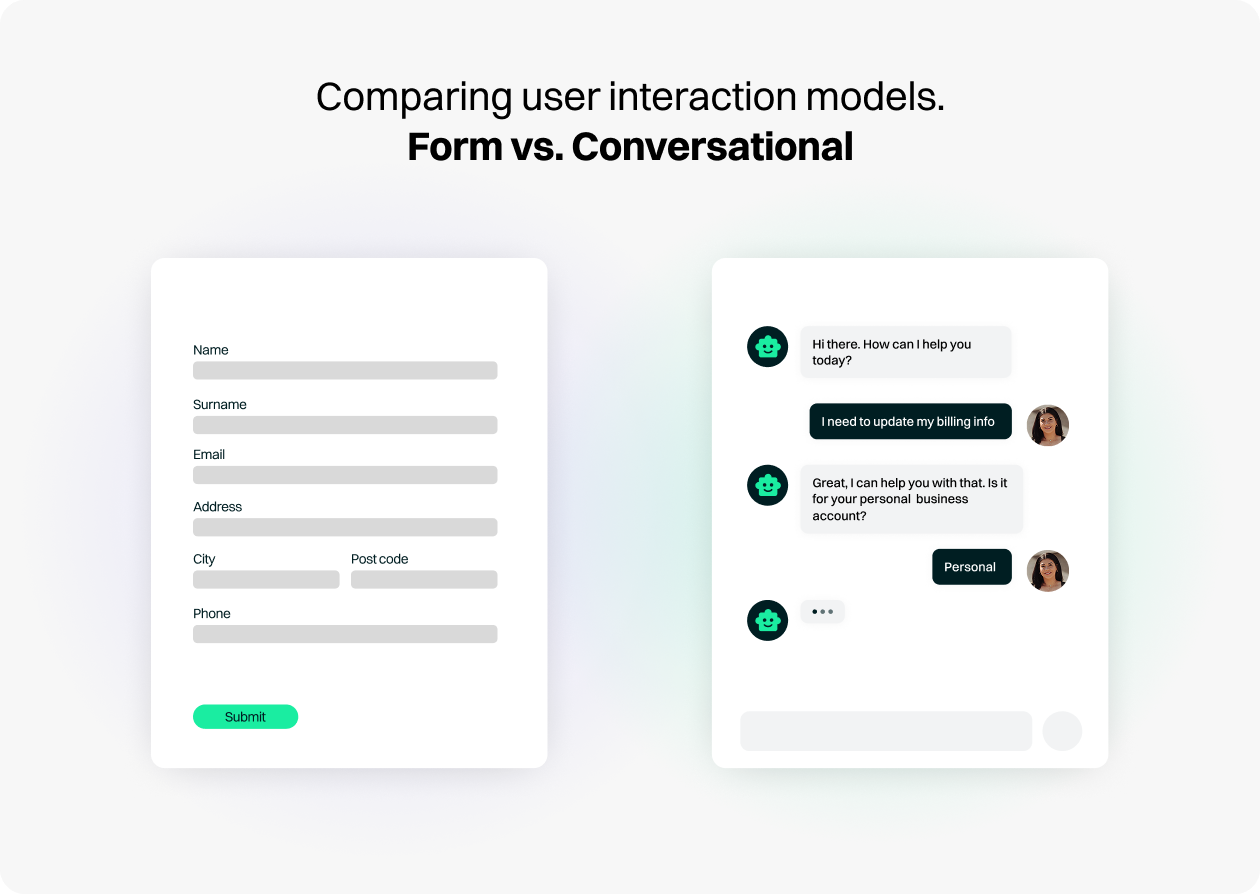
The lead generation model based on forms has been showing signs of fatigue for years. Today’s customer arrives from an ad while waiting for the subway, with three tabs open and a tolerance for friction measured in seconds. An eight-field form is no longer a bridge between the user and the company, it’s the first reason for abandonment.
Conversations should solve this. And in many cases, they don’t—because most bots today are not designed to converse; they are designed to automate. There’s a massive difference between the two. Automating a FAQ means building a repository of information with linear navigation. Designing a conversation means creating a dynamic exchange that adapts to the user, builds trust progressively, and guides toward a decision without making the user feel processed.
Failure patterns repeat consistently: the bot asks for company and phone number before delivering any value; the flow breaks when the user writes something outside predefined options; the tone feels like an instruction manual. The result: high conversation volume, low conversion rate, and a list of leads that the sales team receives with little enthusiasm. Beneath all this lies something harder to quantify but equally real: brand perception damage that no later campaign fully fixes.
Conversational design is not a UX discipline. It is a business discipline. The way a flow is designed directly determines how many leads you generate, their quality, and their readiness to buy.
What conversational design really is
Conversational design is the discipline that defines how a system interacts with a person to achieve a specific objective. It is not interface design or copywriting. It is the architecture of a conversation: what is said, when, in what tone, with what purpose, and how each response leads naturally to the next step.
In a business context, it answers a critical question: how do you turn vague intent into a specific decision without creating pressure or confusion?
It operates at the intersection of three disciplines that rarely sit at the same table: customer experience, sales strategy, and performance marketing. From the first, it takes the obsession with reducing friction. From the second, the logic of qualification and decision progression. From the third, a mindset of continuous testing and data-driven optimization.
The rise of generative AI adds another layer: today, conversations can understand intent behind words, adapt tone in real time, and autonomously decide when to escalate to a human, send a resource, or push for closure.
Anatomy of a high-converting conversational flow
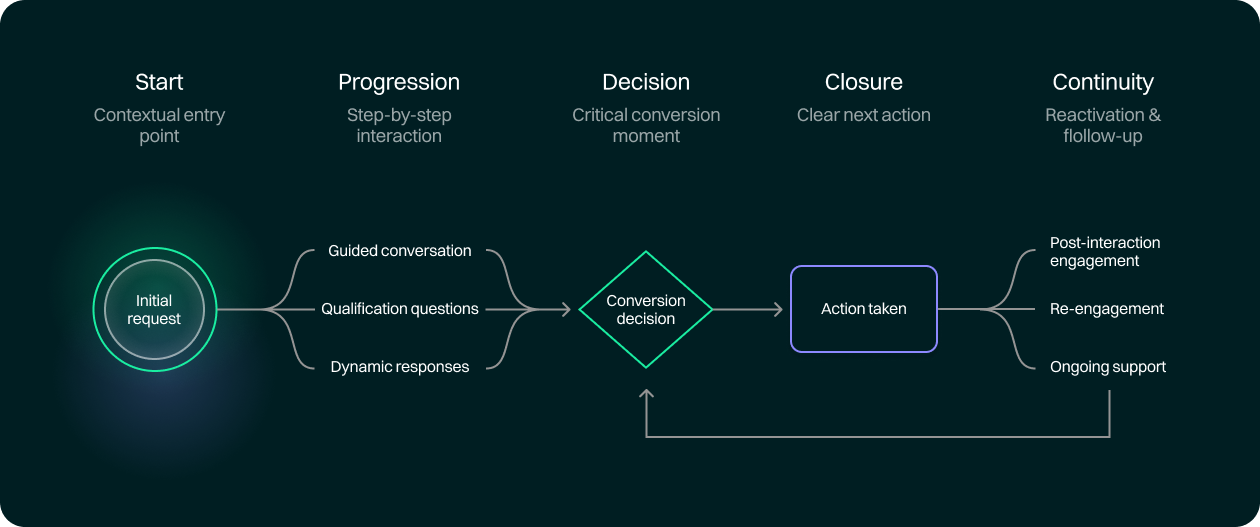
A well-designed flow is not a sequence of questions—it’s a structured progression. Each stage has a distinct goal and a specific type of friction to eliminate.
- Start. The first message determines whether a conversation happens at all. A strong opening takes initiative: it builds on what is already known about the user—where they come from, what page they were browsing—and starts with something relevant. Not “How can I help you?”, but a concrete value proposition.
- Progression. One question at a time. Sensitive data—phone number, company, role—is requested only when enough context and trust exist. Progressive commitment is not a design preference; it’s the difference between a 12% and a 38% conversion rate.
- Decision. The highest abandonment point is, paradoxically, when the user is closest to converting. The flow must remove any obstacle between intent and action: if the user wants to speak to someone, the next step is a calendar—not another form.
- Closure. It doesn’t feel like closing. There is a clear next step: who contacts whom, when, and how. A well-designed confirmation reduces post-conversion anxiety and sets expectations the sales team can fulfill.
- Continuity. The conversation doesn’t end at the first conversion. The most effective flows include reactivation logic for drop-offs and alerts for the sales team when previously inactive users show renewed intent.
The principles that make the difference
Between a flow that converts and one that gets abandoned, there is rarely a single cause. It’s a combination of design decisions—done right or wrong.
Minimal cognitive friction. The mental effort required to understand what’s expected at each step is the silent driver of most drop-offs. Short sentences, one idea per message, and language that reflects how users speak—not how companies speak.
- Real personalization. Not just inserting a name. It’s adapting content and flow based on prior behavior: pages visited, campaign source, past objectio This requires data integration—but the conversion uplift justifies it.
- Timing and context. A bot that triggers two seconds after entering a website creates the opposite effect. Proper context—users spending time on a page, revisiting, or exploring pricing—transforms the same conversation into a completely different experience.
- Transparency. Trust is built through clarity: who you are, what you can do, and how user data will be used. Flows that hide being bots or request information without explanation generate active distrust. Good design is transparent about its limits.
- Integration with the real business. A bot disconnected from the CRM becomes a manual workload generator. True integration means the flow knows the user before they start typing, conversations move across channels seamlessly, and generated data feeds segmentation, scoring, and nurturing beyond acquisition.
The metrics that matter (and a real case)
The number of conversations started or widget CTR are easy to report—but they don’t indicate business impact. What matters are:
- Flow progression rate by stage
- Effective contact rate
- Ratio between declared intent and actual conversion
If 80% drop off after the second message, the issue is the opening. If abandonment spikes when asking for a phone number, the issue is timing or perceived value.
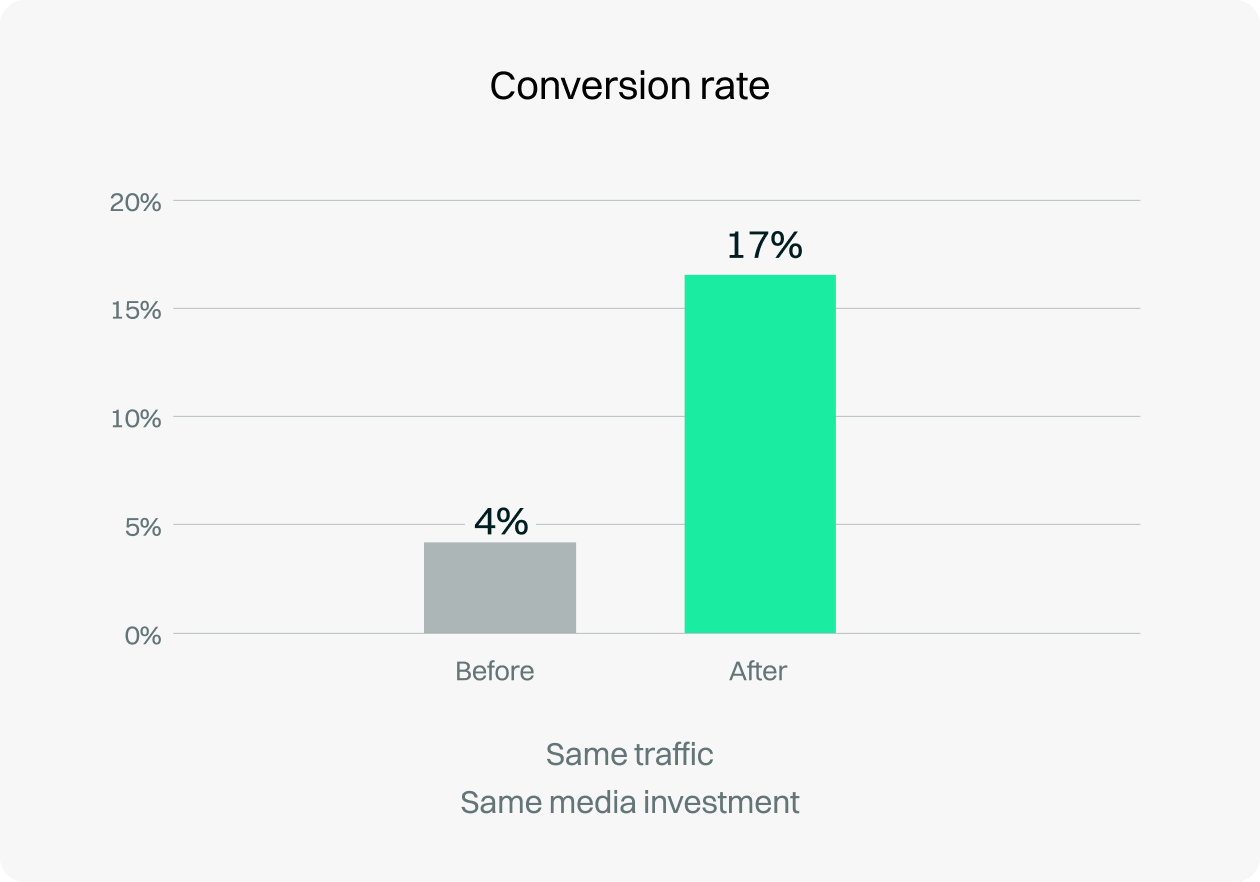
A telecommunications operator in LATAM had a bot generating around 3,000 monthly conversations with a 4% qualified lead conversion rate. The diagnosis was clear: it asked for company and role in the second message before delivering value; the tone felt like a procurement form; and there was no personalization based on entry page.
After redesign—contextual opening, decision-aligned progression, and segment-adapted tone—the conversion rate increased to 17%.
Same traffic. Same media budget. Different design.
When conversational design is measured with the right metrics—customer acquisition cost, sales velocity, customer lifetime value—it stops being a UX improvement project and becomes a business lever that CEOs and CFOs understand instantly.
The next step: from flows to conversational systems
The traditional bot—decision trees and predefined responses—is being replaced by conversational agents that understand context, learn from interactions, and execute actions autonomously.
This evolution doesn’t make conversational design obsolete—it makes it more critical.
It’s no longer enough to define what the bot says at each step. You must define the principles that guide the agent’s behavior, its limits, and how it improves over time.
The cost of inaction is not zero. It’s the cost of converting 4% when you could convert 17%. It’s the cost of low-quality leads consuming sales team time without generating revenue. And it’s the cost of competitors building this capability while you still rely on eight-field forms.
At Convertia, we’ve been building high-converting conversational systems for years: intelligent acquisition, automated qualification, assisted closing, and continuous optimization. We operate under a performance model—if we don’t deliver agreed results, you don’t pay.