











The problem isn’t generating leads. It’s converting them into revenue
There’s a conversation that plays out in nearly every organization with a marketing team and a sales team: marketing says it delivers enough leads, sales says those leads are worthless. Both are right. And neither is looking at the real problem.
The misalignment between marketing and sales is not a people problem — it’s a structural consequence of building the sales funnel as if it were two separate worlds. Marketing optimizes for clicks and form submissions. Sales optimizes for closing. In between, no one is accountable for what happens. That’s exactly where the money is lost.
The volume illusion is the silent enemy of sales efficiency. More leads does not mean a better funnel. It just means more noise around the same underlying problem.
Revenue isn’t lost at the generation stage, nor at closing. It’s lost in the middle — the gap most organizations manage with spreadsheets, subjective criteria, and manual processes that don’t scale. Redesigning the sales funnel starts exactly there.
Why the traditional sales funnel no longer works
The traditional funnel was designed for a linear world. Today, the customer journey looks radically different: fragmented, multi-channel, asynchronous. And most companies’ sales funnels have not evolved at the same pace.
Each channel operates with its own attribution logic and its own success metrics. The result is a partial view of the buyer journey and investment decisions made on incomplete data. When you can’t trace a lead from the first click to real revenue, you optimize for CPL without knowing whether that CPL has any connection to signed contracts or retained customers.
| Traditional Funnel | New Operating Model |
| Channel-by-channel optimization, in silos Primary metric: CPL and volume Manual or non-existent qualification Disconnected data across teams | End-to-end system optimization Primary metric: CPA and real revenue AI-powered automated qualification Full buyer journey traceability |
The critical gap between lead generation and closing is not a technology problem — it’s a design problem. No one deliberately created that void, but no one has deliberately filled it either.
The new operating model: A sales funnel built to convert
The difference between a theoretical model and a real operating model is that the latter has consequences: on processes, on technology, on roles, and on how success is measured. An operating model defines who does what, with what data, at what moment, and how they know they’re doing it right.
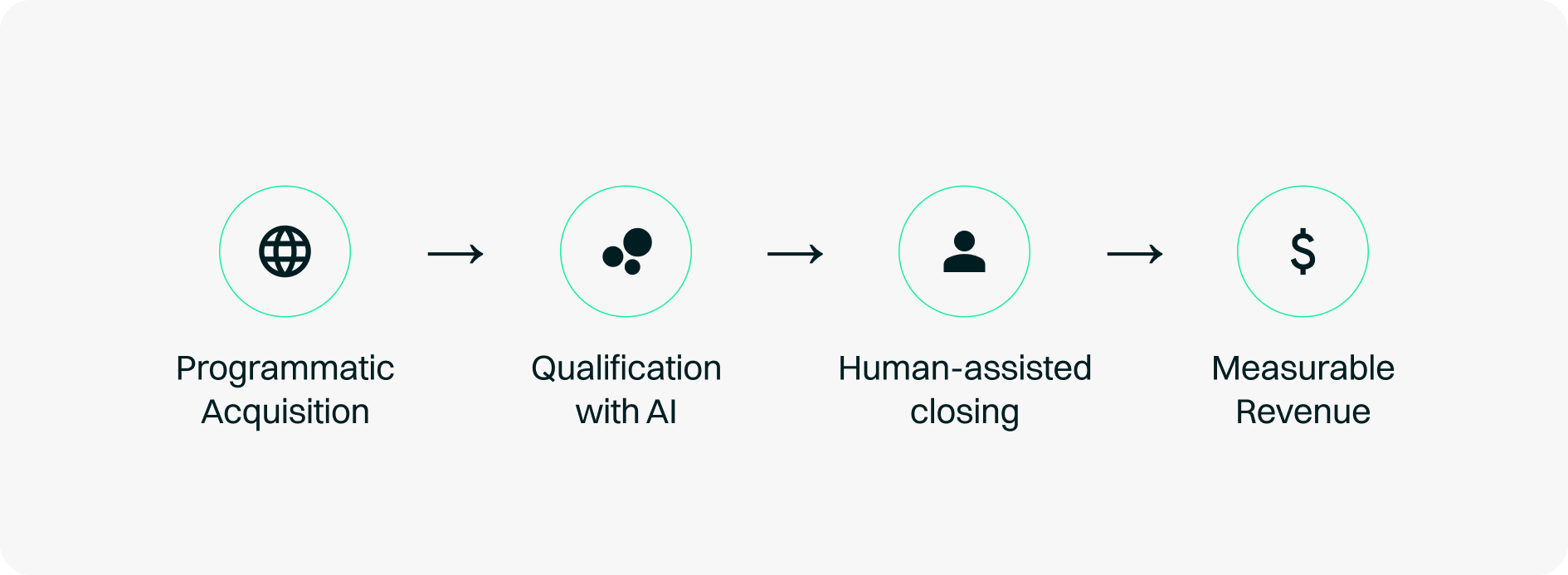
Each stage must be designed in terms of the next, not its own internal metrics. Lead acquisition is not measured in leads — it’s measured in the quality of those that reach qualification. Qualification is not measured in contacts — it’s measured in real opportunities that reach the sales team. And closing is not just measured in won deals, but in the value and speed at which that revenue is generated.
Programmatic lead scquisition: Attract with intent, not just volume
What «programmatic» really means today is the ability to activate audiences, bids, and creatives in an automated, real-time fashion, based on behavioral and intent signals. The difference between well-executed programmatic lead acquisition and a simple traffic buy lies in which signals you use to make decisions.
Vanity metrics — impressions, clicks, CTR — tell you whether someone saw your ad. Value signals tell you whether that person has characteristics Multiplied by the volume of media investment, that difference determines whether your sales funnel starts strong or weak from the very first dollar spent.
A mature programmatic acquisition system feeds on CRM data, qualification process outcomes, and the closing patterns of the sales team. That feedback loop — from revenue back to acquisition — is what transforms a campaign into an acquisition system that improves over time.
AI-Powered lead qualification: Where deals are won or lost
If there’s one stage of the sales funnel where the greatest improvement potential — and the greatest drop-off risk — is concentrated, it’s qualification. This is the moment when a lead that has shown interest either becomes, or fails to become, a real opportunity.
Artificial intelligence agents have fundamentally changed what’s possible at this stage. We’re not talking about chatbots with pre-scripted responses — we’re talking about systems capable of holding contextualized conversations, capturing intent signals in real time, dynamically prioritizing leads, and handing off to the human team at the optimal moment, with full context.
The conversation is not the qualification channel. It is the conversion engine.
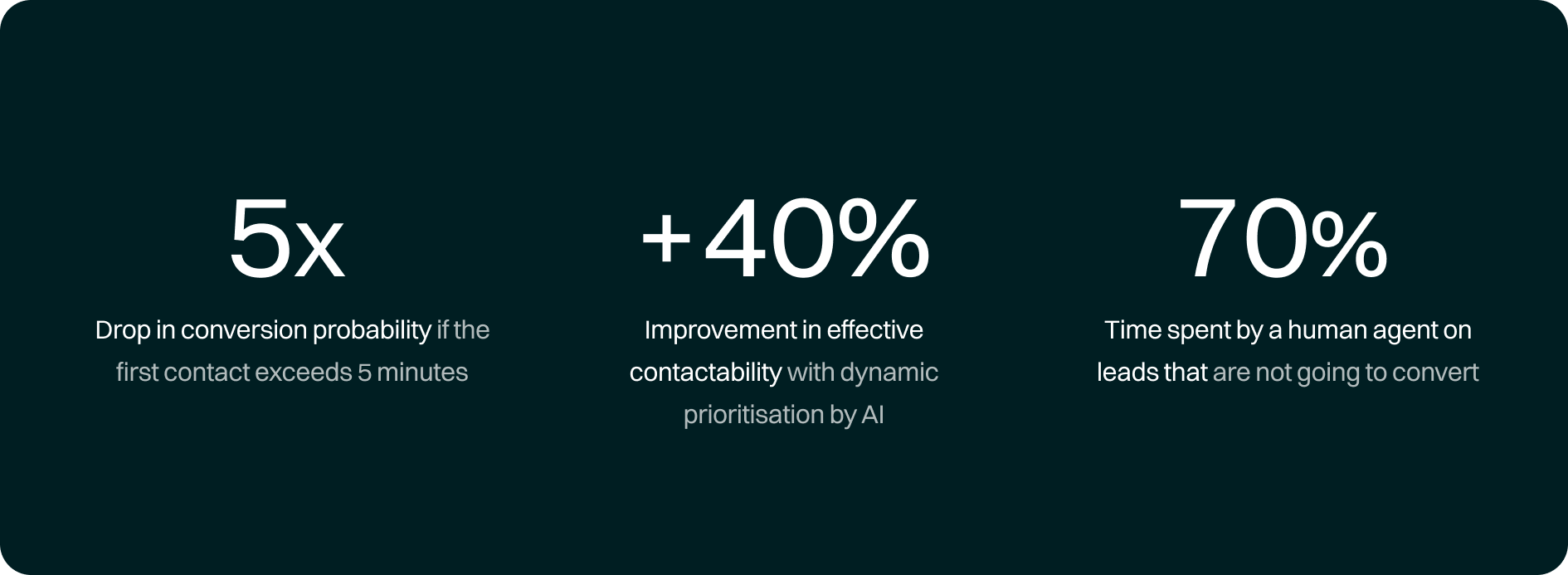
Accelerating the decision-making cycle is perhaps the least visible yet most strategic benefit. A lead that takes three weeks to convert has giving competitors more time to intercept them, allowing their urgency to fade, and letting the context that motivated them to dissipate. AI-powered qualification systematically and measurably compresses that cycle.
Human closing: The moment where everything converges
Closing is the most relationally complex moment in the sales process, and that complexity requires capabilities that AI systems don’t yet have: contextual empathy, real-time negotiation, handling unexpected objections. The human is irreplaceable here — but the relevant question is not whether humans should close, but how leads should arrive in their hands.
How leads should reach the human agent
In the new model, the lead that reaches the human agent is not a cold contact. It’s a qualified opportunity with a full interaction history, detected intent, and an optimally calculated contact moment. The agent doesn’t start from zero — they start from the point of maximum conversion potential.

The synchronization between AI and human agents is the hinge that makes the entire model work. The handoff must be fluid and instantaneous: the human agent receives not just the lead, but all the accumulated intelligence about that lead. This fundamentally changes the sales conversation.
The metrics that actually matter in the new funnel
Changing the operating model without changing the metrics is one of the most common ways to undermine a transformation. If the marketing team is still evaluated by CPL, they will optimize for CPL. Metrics define behavior.
The most important transition is from CPL to CPA — and beyond that, to real revenue. Even CPA is insufficient if it’s not connected to the lifetime value of the acquired customer. A low CPA in a low-value segment can be a worse business outcome than a high CPA in a high-retention segment.
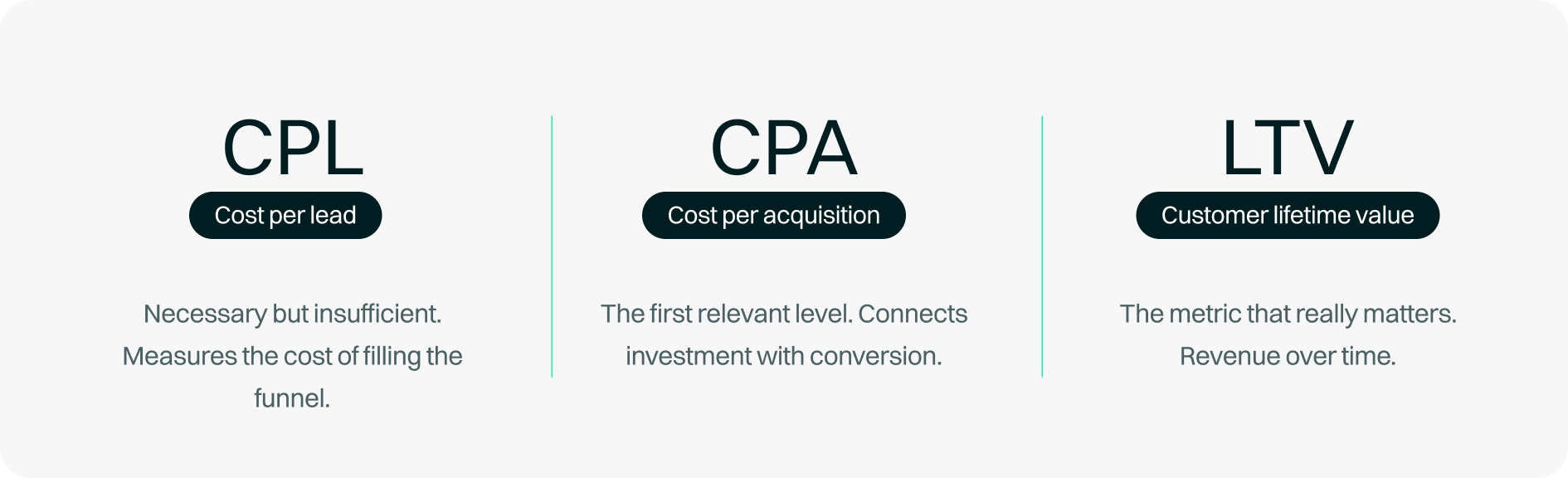
The metric chain that actually matters includes effective contact rate, qualification rate, conversion velocity, and close rate by segment. Together, they allow you to pinpoint exactly where value is being lost in your specific sales funnel, instead of chasing symptoms without addressing root causes.
Stop managing leads. Start building revenue
There’s a question that, answered honestly, changes everything: is your organization designed to generate leads or to build revenue? These are not the same question, and the answer to one does not imply the answer to the other.
Managing leads is an operational function. Building revenue is a strategic function. The problem is that for years the industry has conflated the two, measuring the latter with the metrics of the former. The result is dashboards full of activity and pipelines that don’t convert at the pace they should.
Programmatic lead acquisition, AI-powered qualification, and human closing are not three independent tools — they are the three phases of a system designed around a single obsession: revenue. When that system works well, metrics don’t just improve. The way the organization understands its own business fundamentally changes.
The next step is not technological. It’s deciding whether your organization wants to keep managing leads or truly start building revenue. That sales funnel already exists. The question is whether you’re ready to build it.