



The conversational channel is no longer a customer service resource. It is — or should be — your best salesperson. The shift from chatbot to AI sales agent is not a technology upgrade: it is a complete rethinking of how you generate revenue and manage customer relationships from the very first message.
Chatbot vs. AI Agent: Not an Evolution, a New Commercial Model
When companies first deployed chatbots on their websites and messaging channels, the promise was compelling: automate responses, reduce the workload on human teams, and be available around the clock. For a while, that was enough.
The problem is not that chatbots are a bad technology. The problem is that they solve the wrong problem. They were designed to handle query volume, not to generate revenue. And that is the fundamental gap between both models.
Moving from chatbot to AI sales agent is not about installing an upgraded version of the same system. It means redefining what role conversation plays within your commercial model.
The conversational AI agent was not built to replace the chatbot with better answers. It was built to take on something far more ambitious: actively managing the sales process in a contextual, connected way across your entire operation. What is at stake is not the efficiency of a channel. It is conversion, customer acquisition cost (CAC), and total revenue.
Many Chats, Few Sales: The Real Problem with Current Conversational Automation
If you manage a marketing or sales team, you probably recognize this pattern: conversation volumes have grown, engagement metrics look reasonable — but further down the funnel, the picture is very different. Leads are not converting. Or they are being lost. Or they arrive to the sales team already cold, without context, poorly qualified.
Chatbots with no real business impact have become one of the most widespread phenomena in the B2B and B2C digital ecosystem. The conversational channel was deployed as a tactical tool — typically under customer service or digital marketing — without redesigning the commercial process around it. The result: conversations that go nowhere, trapped in closed flows that do not know what to do when the user goes off-script.
The Most Common Measurement Error in Sales Automation
Measuring conversational success by the volume of leads captured — rather than by sales closed — leads to wrong decisions about what to improve, where to invest, and which sales technology to prioritize. This metric bias is, in many cases, the real barrier to scaling results.
What Is a Conversational AI Agent and Why It Transforms Lead Conversion
An AI sales agent does not operate on predefined flows. It operates on context, intent, and timing. It understands what the user is looking for beyond the literal words they use, interprets where they are in the decision-making process, and adapts its behavior in real time to maximize the probability of closing.
This radically changes what is possible in a commercial conversation. A well-configured AI agent can:
- Initiate a lead qualification interaction without it feeling like a form
- Detect high purchase-intent signals and increase the urgency of the message
- Connect to the CRM to retrieve the contact’s previous interaction history
- Respond to common objections with arguments personalized to the user’s profile
- Hand off the conversation to a human agent — with all accumulated context — at exactly the moment when the probability of closing is highest
What structurally distinguishes the AI agent from the chatbot is this: the chatbot reacts. The AI agent acts. It has goals, the ability to make intermediate decisions to reach them, and access to the systems needed to execute them. This makes it a real participant in the sales process — not a pre-filter before the process.

Chatbot vs. AI Agent: Key Differences That Impact Revenue
Beyond technical terminology, what matters is understanding the practical consequences each model has on your business results. The table below compares both approaches from a commercial perspective:
| Dimension | Traditional Chatbot | Conversational AI Agent |
| Type of conversation | Guided by rigid predefined flows | Adaptive, oriented toward sales goals |
| Personalization | Low — generic responses for everyone | High — contextualized by user, history, and intent |
| Purchase intent detection | Does not detect purchase intent signals | Identifies and acts on high-conversion moments |
| CRM & systems integration | Limited or nonexistent | Native: CRM, contact center, data layer in real time |
| Role in the sales funnel | Pre-support or basic pre-qualification | Active participant in the sales closing process |
| Typical business outcome | Operational efficiency, no revenue impact | Increased conversion, qualified leads, and closed sales |
From Customer Service Channel to End-to-End Sales Channel
The most important turning point introduced by the AI sales agent is not technical — it is strategic. The conversation stops being the first step of a process that continues elsewhere — a form, a phone call, a sales visit — and becomes the sales channel itself.
A well-orchestrated intelligent conversation can completely replace the role of a landing page and a lead capture form. It can qualify, persuade, handle objections, and close — all within the same message thread. The user does not have to leave where they already are to complete the process. And in terms of lead conversion, that changes everything.
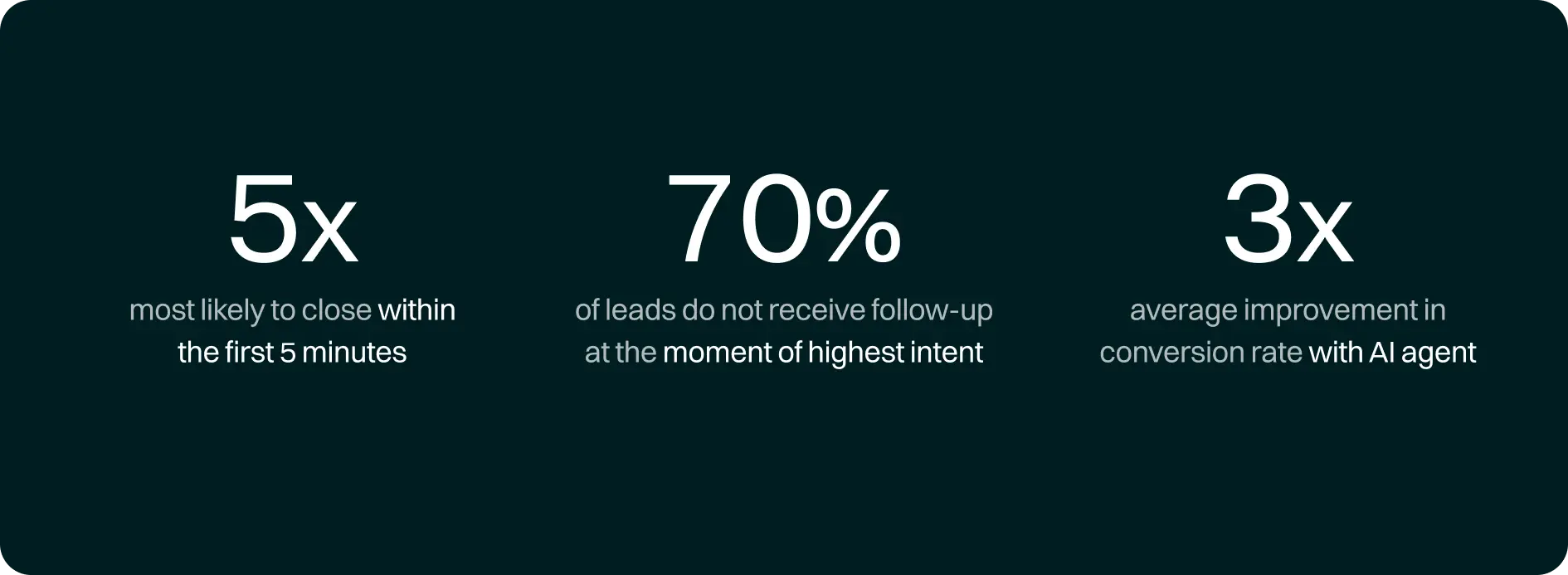
One of the most costly problems in digital marketing and demand generation is the loss of contactability: the user who fills out a form at 11 PM and does not receive a response until the following day. By then, 70% have already moved forward with another provider. The AI agent solves this structurally: it acts at the exact moment — when the user is available, motivated, and expecting a response.
Key Data on Response Speed and Lead Conversion
The Business Metrics That Matter in AI for Sales
One of the most important transformations of the conversational AI agent model is the ability to measure the channel using the same metrics you use to evaluate any other commercial investment. When you can attribute a closed sale to a specific conversation, optimization decisions change completely. You stop guessing. You measure.
| Traditional Metric | → | Revenue-Oriented Metric |
| CTR / CPL | → | CPA and revenue per conversation (cost to close) |
| Total number of conversations | → | Real conversion rate (% reaching an actual sale) |
| Call deflection | → | Conversational channel ROAS (return on attributed sales) |
| CSAT / one-off satisfaction | → | End-to-end traceability from first message to close |
The Hidden Cost of Not Moving from Chatbot to AI Agent
The cost of staying with the traditional chatbot model is not static. It grows over time — and it does so in ways that are not always visible in the short term:
- Increasing operational costs with no improvement in results: more conversations, more flows to maintain, more staff to handle bot exceptions — and the same lead conversion rates.
- Lost opportunities at the moment of decision: invisible in reports, but enormously costly. The user who abandons because the chatbot could not answer their real question rarely comes back.
- Accumulated competitive disadvantage: companies already operating with AI agents capture opportunities faster, with less friction, and at a lower acquisition cost (CAC).
- Dependence on fragmented models: this creates inconsistencies in the customer experience that translate into permanent operational inefficiency and erosion of brand trust.
Implementing an AI Sales Agent: It Is Not About Technology, It Is About Redesigning How You Sell
Conversation has always been the moment when a company and a customer meet. What has changed is that it is now possible to make that meeting intelligent, timely, and connected to all relevant information from the very first message. The chatbot maintained the conversation. The conversational AI agent actively works it toward a close.
The leap from unconverted leads to real revenue is not achieved by improving the metrics of what you already have. It is achieved by changing the model. And that model starts with deciding that the conversational channel is not a support tool — it is your primary sales asset.
The AI agent is not the improved version of the chatbot. It is the first step toward a commercial operation where every conversation has the potential to become a closed sale.
Is your conversational channel generating revenue — or just managing volume?
At Convertia, we help companies evolve toward end-to-end conversational models that connect marketing, sales, and customer service on a single intelligence layer. Talk to our team and discover how an AI agent can transform your sales funnel.
Everything you need to know to get started
The fundamental difference lies in the capacity for action and access to context. A chatbot follows predefined flows and answers specific questions within a decision tree. A conversational AI agent understands the user’s intent, accesses external systems like the CRM in real time, detects purchase-intent signals, and makes autonomous decisions to move the conversation toward a close. It does not just inform — it actively sells.
No, and that should not be the goal. The AI agent is designed to handle the initial volume of conversations, qualify leads, resolve common objections, and identify the exact moment of highest purchase intent. At that point, it can hand off the conversation to the human salesperson with all accumulated context. The result is that your human team spends its time closing real opportunities — not filtering cold leads. The AI agent amplifies sales productivity; it does not replace it.
It depends on the level of integration with your current systems (CRM, contact center, data layer), the complexity of the sales process, and the number of channels you want to cover. In most cases, a functional first version can be live within a few weeks. The most important factor is not the speed of the technical implementation — it is the prior design of the commercial process the agent will execute. Without that strategic groundwork, the technology will not deliver results.
The ROI of a conversational AI agent is measured using the same metrics as any other commercial investment: cost per acquisition (CPA), revenue attributed per conversation, lead-to-closed-sale conversion rate, and conversational channel ROAS. Unlike a traditional chatbot, the AI agent enables end-to-end traceability from the first message to the close — making precise attribution possible and allowing optimization decisions based on real data, not assumptions.