










Traditional BPO was designed to manage operations. Today, companies need something different: a model built to drive growth. They are not the same thing, and the difference has consequences.
When operational efficiency is no longer enough
For decades, the BPO model addressed a real need: managing commercial volume without overloading internal structures. Outsourcing part of the operation provided flexibility, controlled fixed costs, and allowed scaling capacity without hiring. In that context, the model made perfect sense.
The problem is not the model itself. The problem is that the context has changed, and the traditional version of the model has not.
Companies no longer compete solely on operational capacity. They compete on funnel efficiency, conversion speed, and profitability per customer. In that environment, managing activity well does not guarantee growth.
Three tensions that appear when the model no longer fits
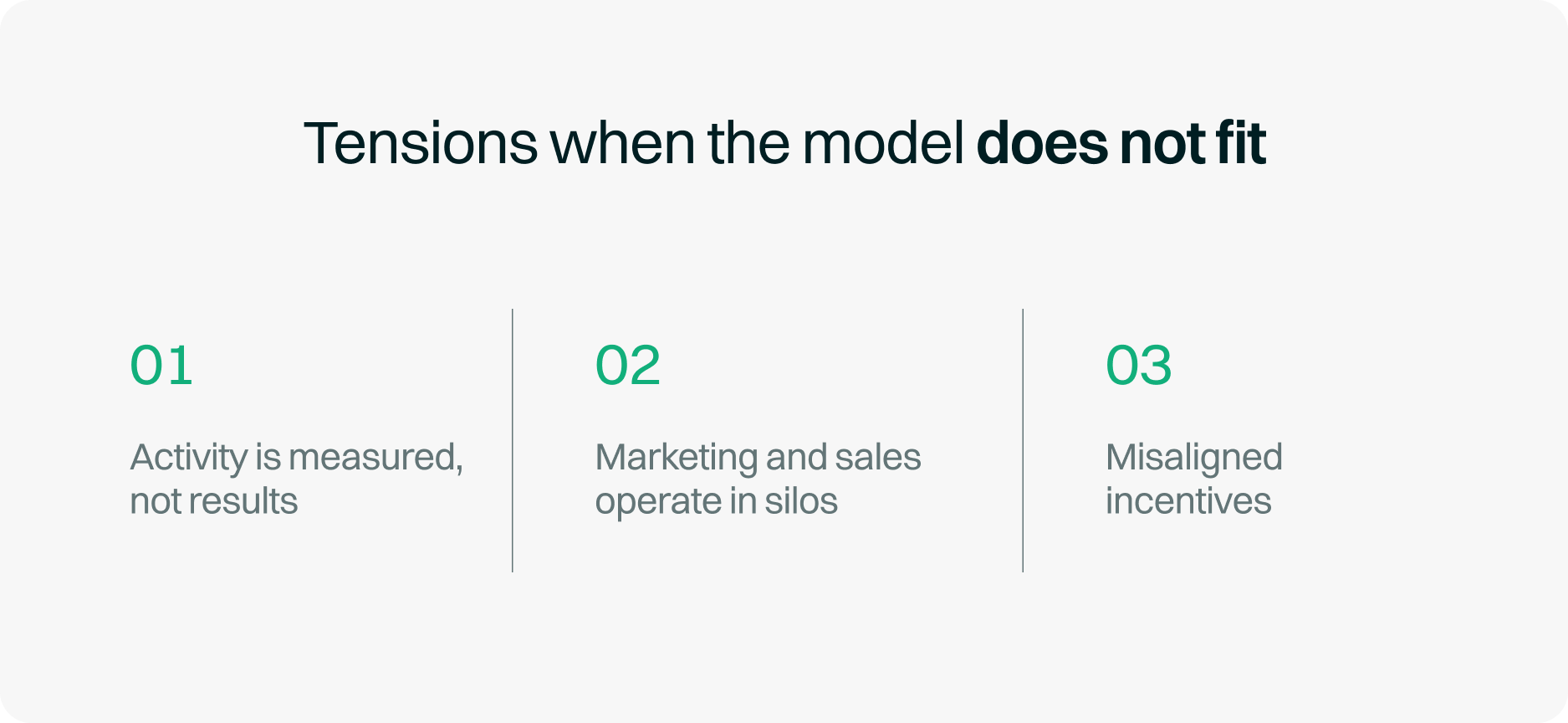
Activity is measured, not results
Traditional BPO KPIs are operational by design: call volume, average handling time, service levels. These are reasonable metrics for managing operations. But they are disconnected from the metrics that truly matter to the business: real conversion, CAC, margin, recurrence.
Marketing and sales operate in silos
Leads are generated on one side, worked on another, with a boundary in between that no one fully crosses. There is no systematic feedback, no real-time shared data, no joint optimization.
Incentives are not aligned
A provider paid by hours or structure has no direct economic incentive to improve your conversion rate. You assume the outcome risk. They provide capacity.
Integrating, automating, and aligning to results
AI applied to contact centers and commercial processes transforms the logic of how the funnel operates when fully integrated across the entire journey.
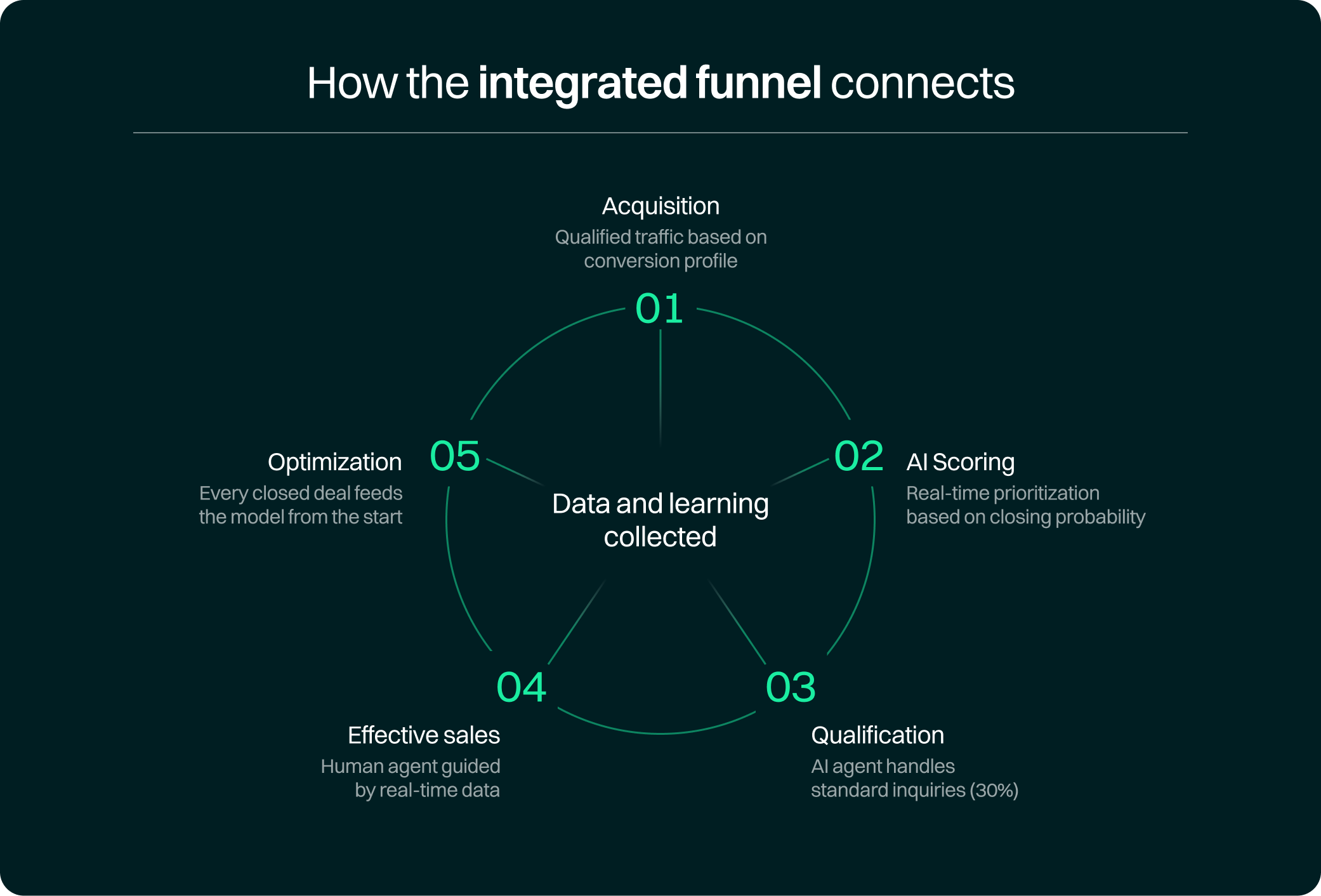
Traditional BPO vs. integrated model
Traditional BPO focuses on operational KPIs such as calls, AHT, and SLA. The integrated model focuses on business KPIs such as conversion, CAC, and ARPU.
Traditional BPO operates under fixed-cost structures. The integrated model aligns economically with CPA, CPL, or hybrid performance schemes.
What it means to be the alternative to traditional BPO
Being an alternative means redesigning the model so every component aligns with driving sustainable and profitable sales growth.
At Convertia, we integrate digital acquisition, AI automation, commercial operations, and analytics under a unified performance logic.
Conclusion
The debate is not about changing providers. It is about evolving the model. Let’s explore how Convertia can help you improve your entire digital acquisition process and optimize costs so the business wins.