










At the monthly results meeting, the sales director presents a strong month: the sales network closed more pre-need funeral plans than in the same period last year. Minutes later, the collections team shows a different figure: a share of the plans sold a quarter ago already has unpaid installments or has been cancelled. Both figures are correct. The problem is that no one in the room can say with certainty which channel, which sales agent or which type of conversation produced the members who keep paying.
This scene is illustrative, but it describes a common tension at pre-need funeral plan companies. The business model works like a long-term subscription, with monthly installments over many years. The sales operation, however, is usually measured as a one-time sale. To grow plan membership sustainably, that gap is the first one worth closing.
A Subscription Business Measured as a One-Time Sale
In a pre-need plan, a member’s value builds over time. Signing the contract opens the financial relationship, and the return comes with every installment paid. Even so, the KPIs that dominate sales management in the funeral industry are still visits made, leads generated and sales closed in the month.
These metrics are useful for managing day-to-day activity, but they leave out the question that weighs most on profitability: how much does it cost to acquire a member who stays active? When that figure isn’t calculated, cancellations and late payments are treated as a collections problem, separate from the way the customer was acquired.
A Hypothetical Exercise
Let’s assume a company invests the same budget, 10,000 monetary units, in two channels over one quarter:
| Channel | Enrollments Generated | Active Members (12 Months) | Retention Rate (%) | Cost per Enrollment | Annual Cost per Active Member |
| Channel A | 100 | 55 | 55% | 100 | ~182 |
| Channel B | 70 | 60 | 85.7% | 143 | 167 |
Looking at cost per enrollment, Channel A seems better. However, looking at annual cost per active member, the order is reversed: about 182 units for Channel A versus 167 for Channel B. The figures are made up for this example, but the logic applies to any member portfolio: the decision about where to invest changes depending on when you measure.
Where the Chain Between Lead Generation and Enrollment Breaks
At many companies in the funeral industry, digital lead generation and the sales force operate as separate worlds. Marketing delivers leads, while the agent network or telemarketing team works them using its own criteria. Collections show up months later in another system. Each area sees its own stretch of the customer journey, and none sees the full journey.
This has concrete consequences for day-to-day operations:
- Marketing doesn’t know which campaigns end in paying members, so it ends up optimizing for lead volume.
- Prospects who don’t decide in the first conversation are left without structured follow-up, even though decisions about a family plan are usually made calmly and among several people.
- Management can’t use data to compare the performance of its in-house network, an outsourced provider or a digital channel.
The long decision cycle deserves special attention. A family that requests information about a pre-need plan may need weeks to talk it over. If the only follow-up depends on the memory of a commission-based agent, and turnover in that sales force is high, the interest walks out the door with the agent who leaves.
Pre-Need and At-Need: Two Different Conversations
Any sales analysis of the funeral industry must start from one distinction. At-need funeral services are purchased in the middle of a loss, with urgency and little capacity to compare options. A pre-need plan is decided while alive, in a moment of calm, as a financial decision and a source of peace of mind for the family.
Regulators have focused on the first scenario. In Chile, the National Economic Prosecutor’s Office (Fiscalía Nacional Económica) launched a study of the funeral market in 2021 after observing wide price dispersion among very similar services. As a possible explanation, it pointed out that people often purchase these services under strong emotional vulnerability. In Mexico, PROFECO (the Federal Consumer Protection Agency) regulates pre-need funeral contracts and advises consumers to verify that they are registered. In Colombia, pre-need funeral companies operate under a supervisory regime because of the prepaid nature of their plans.
Our view is that this context turns sales quality into a commercial variable, not just an ethical one. A pre-need sale made under pressure or with incomplete information is more likely to end in early cancellation or a complaint. A consultative, documented conversation without artificial urgency protects the brand’s reputation and, at the same time, portfolio persistency. In at-need service, the priority is to support the family, not to sell.
What to Review to Grow Members Who Stay
Before adding budget or sales agents, it’s worth reviewing five points in your operation:
- A shared definition of active member. Marketing, sales and collections should use the same one, with measurement checkpoints at three, six and twelve months.
- Traceability from the source. Each enrollment should retain the channel, campaign and agent that generated it, so it can later be cross-referenced with payment behavior.
- Follow-up rules for prospects who don’t decide at first contact. Define when to call back, through which channel, with what information and when to stop insisting.
- Pre-qualification before closing. Assessing the prospect’s ability to pay and life stage helps offer the right plan and reduces enrollments that are unlikely to last.
- Auditable scripts and protocols. What is said in each conversation should be approved by the sales and quality teams, and be reviewable afterward.
None of these points requires replacing the existing sales network. What they require is that the network, digital channels and collections share information.
Technology and People in a Single Workflow
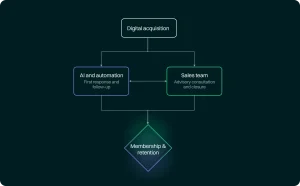
Once these points are addressed, technology plays a precise role. A connected CRM lets you see each member’s complete journey, from first contact to payment behavior. Marketing automation sustains follow-up with families who need time to decide. Omnichannel customer service, including WhatsApp, makes it possible to respond through each person’s preferred channel. AI agents can handle the first response and reminders, leaving the consultative conversation in human hands.
The human component remains central for such a sensitive product. A sales team trained on the product and in empathetic communication can complement the in-house network in areas without coverage or during demand peaks. To do so, it must work with the same scripts, the same KPIs and the same definition of success.
Measure What Sustains the Business
The funeral companies that grow most in pre-need won’t necessarily be the ones that sign the most contracts this month. They will be the ones that know which channels, conversations and processes produce members who remain active years later, and that invest accordingly.
Does your company know how many of the members it acquired last year are still active, and which channel they came from? At Convertia, we can review with you how your lead generation, follow-up and sales closing connect today, to identify where you’re losing the members your business needs to retain.