










The problem: churn costs more than it seems
In the telecommunications sector across Latin America, competition for customers is brutal. Price sensitivity is high, competitor offers are constant, and switching providers is increasingly easy. In this context, churn (the loss of active customers) stops being an operational metric and becomes a strategic problem that directly erodes margin.
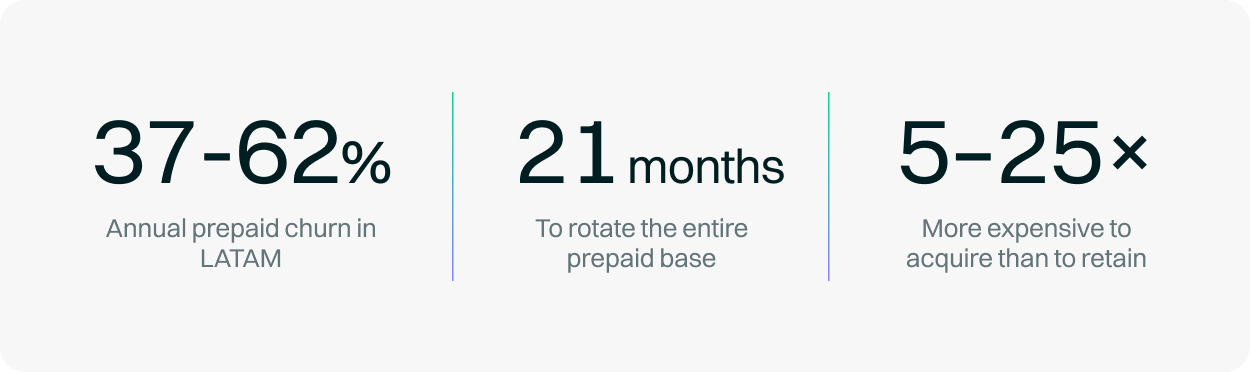
But churn does not act alone. Telecommunications companies face two additional fronts that impact recurring revenue with the same intensity: a massive prepaid user base that never moves to contract, and a growing pool of delinquency with every billing cycle. Managing these three fronts well — and at scale — is the central challenge of today’s telco business.
Within churn, there is a particularly costly variant: clawback — cancellations before the minimum commitment period ends. This means losing the customer before recovering customer acquisition cost while also managing commission repayments. In markets with strong indirect distribution, clawback can represent 15%–30% of monthly activations, turning acquisition into a net cost.
The traditional response — mass campaigns, last-minute discounts and unprioritized collections lists — is no longer enough. Artificial intelligence is offering an alternative already leveraged by leading commercial teams.
Why now?
85% of telecommunications companies globally identify AI as key to operational efficiency by 2026 (GSMA Intelligence).
In LATAM, telecom is one of the most active sectors in AI adoption. The question is no longer whether, but who first.
AI does not replace the team. It makes it ten times more effective
When discussing AI in retention, migration and collections, we are not talking about FAQ bots. We are talking about systems that analyze portfolio behavior in real time, identify customers likely to churn before they know it, and detect the ideal moment to act — with the right context, offer and timing.
AI is a transversal intelligence layer. It spans retention, sales and collections simultaneously. Its value is not replacing human talent but removing low-value work so teams can focus on conversations that drive revenue.
The model that works
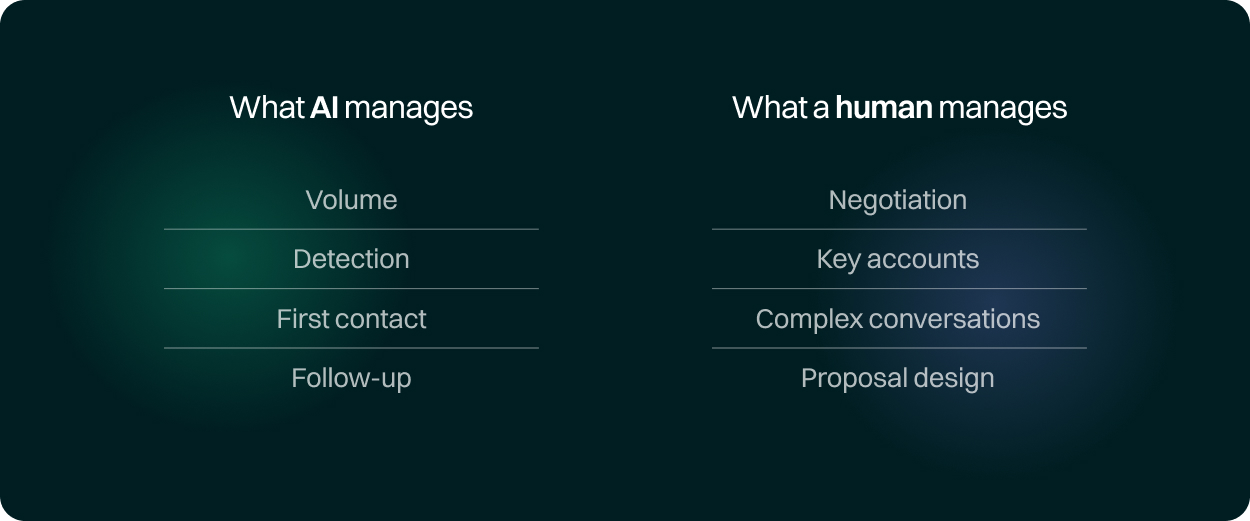
The AI agent manages volume: detection, prioritization, first contact and automated follow-up. The human agent manages value: complex conversations, negotiation and high-impact accounts.
The result: greater portfolio coverage, higher precision and no headcount growth.

Three business levers, one AI engine
1. Retention: from last-minute rescue to proactive prevention
Reactive retention is expensive and ineffective. The customer calls to cancel and teams negotiate from weakness, offering margin-eroding discounts. Predictive AI reverses this.
Models continuously assign a real-time churn risk score. Retention teams receive prioritized daily lists with context and recommended offers — before dialing.
In clawback, AI enables action within the critical 30–60 day window after activation. Early signals — low activation, under-usage, lack of service adoption — trigger engagement before cancellation.
The objective is not only retention but profitability of every activation.
In large B2C portfolios, AI agents autonomously handle first contact for medium-risk customers while humans focus on high-value cases. In B2B or high-ticket portfolios, human agents remain central but operate with unprecedented precision.
2. Contract migration: ARPU waiting to be activated
Across LATAM, telecom bases are predominantly prepaid. Customers are active, with history and predictable consumption, yet rarely receive the right contract proposal. The result is ARPU below potential.
AI identifies users whose consumption profile, recharge frequency and tenure make migration viable and builds personalized offers aligned with real usage.
Conversations can start autonomously through AI agents across digital channels, WhatsApp or voice, escalating to humans when needed. The goal is not pressure — it is making the decision obvious.
Double business impact
Migrating prepaid users to contract increases ARPU immediately and reduces churn probability dramatically. Migration is both revenue growth and portfolio stability.
3. Collections: recovering revenue without losing the customer
Collections carry a hidden cost: doing it wrong. Poor timing or aggressive tone can convert temporary delinquency into permanent churn.
AI enables precise segmentation of delinquent portfolios — distinguishing temporary liquidity issues, chronic default and early churn signals. Each segment receives a different strategy, tone and channel.
Autonomous first contact handles volume with empathy and clarity. Complex negotiations move to human teams with full context. Cases signaling churn route directly to retention, reframing the conversation.
Results across the three fronts
| Retention | Contract migration | Collections | |
| Key result | Up to 30% churn reduction with predictive AI. Clawback decreases through early detection. | Direct ARPU growth via prepaid-to-postpaid conversion.
| Higher recovery rates with lower cost without damaging relationships. |
| Team advantage | Agents focus on accounts that matter, with full context. | Usage-based proposals replace generic campaigns. | Automated first contact, human negotiation. |
| Business impact | Lower customer acquisition cost due to fewer replacements. | Greater portfolio stability — postpaid customers churn less. | Recovered revenue without structural growth. |
The human agent: more strategic, not less relevant
Fear of displacement is common, but reality shows the opposite. AI acts as co-pilot.
Teams spend less time on fragmented data search, low-potential calls and administrative tasks, and more on negotiation and complex conversations.
McKinsey reports 15–20% operational cost savings in LATAM telcos implementing agent-support AI, alongside improvements in customer experience and satisfaction. 77% of telecom companies are already investing.
Where to start
AI adoption does not require replacing systems. The most effective approach is connecting intelligence layers to existing workflows and scaling automation progressively.
- Step one: connect predictive models to CRM, billing and support data to enable churn scoring, migration propensity and delinquency segmentation.
- Step two: integrate agent copilots — pre-call briefings, in-call guidance and automated wrap-up.
- Step three: selective automation of low-complexity contacts, freeing teams for high-value work.
The prerequisite: data quality and centralization. AI accuracy depends on customer data maturity.
Advantage belongs to those who start earlier
Retaining customers, converting prepaid bases and recovering revenue share one requirement: working smarter with existing data.
Telecom companies gaining ground are those that moved from mass campaigns to precision action — right customer, right moment, right offer.
AI enables precision at scale. Every month without adoption widens the gap.
55% of telecom companies plan new AI services in 2025–2026. Those already implementing are building a structural advantage.
Want to see how this applies to your business?
At Convertia, we help telecommunications companies activate AI across retention, migration and collections, keeping the human agent at the center and delivering measurable revenue impact within weeks.