











The silent metamorphosis of Customer Service
The customer service landscape is undergoing a radical transformation. While some sectors are still debating their implementation, AI-powered virtual agents are already redefining the rules of the game, setting new standards that organizations must reach to maintain their competitiveness.
This revolution is not limited to the automation of simple responses. Current systems represent a qualitative leap in machines’ ability to understand natural language, recognize intentions, process emotions, and offer personalized solutions with a precision previously reserved for the best human agents.
The pandemic accelerated this trend exponentially. According to a 2023 McKinsey & Company study, 71% of consumers now expect to be able to solve their doubts or problems without human interaction, a significant increase compared to previous years.
The evolution of Virtual Assistants
From rigid script to contextual understanding
The first chatbots emerged as tools programmed to recognize keywords and offer predefined responses. Their utility, although revolutionary, remained limited when faced with complex inquiries or those formulated in unexpected ways.
The introduction of Natural Language Processing (NLP) algorithms marked the first significant turning point. These systems, although still limited, could extract meaning from complete sentences and respond with some flexibility, adapting to different ways of posing the same question.
The real change came with the implementation of deep learning models and neural transformers. These systems not only understand language but also capture contextual nuances, remember previous conversations, and recognize the underlying intent of each query.
Cognitive Agents
The current generation of virtual assistants incorporates cognitive capabilities that transcend mere language understanding. These systems:
- Learn continuously from every interaction.
- Adapt their communication according to the detected psychological profile.
- Anticipate needs based on historical patterns.
- Optimize solutions through scenario simulation.
- Integrate contextual information from multiple sources.
Virtual agents have evolved from simple conversational interfaces to true digital collaborators with predictive and adaptive capabilities, completely transforming what we understand as customer service.
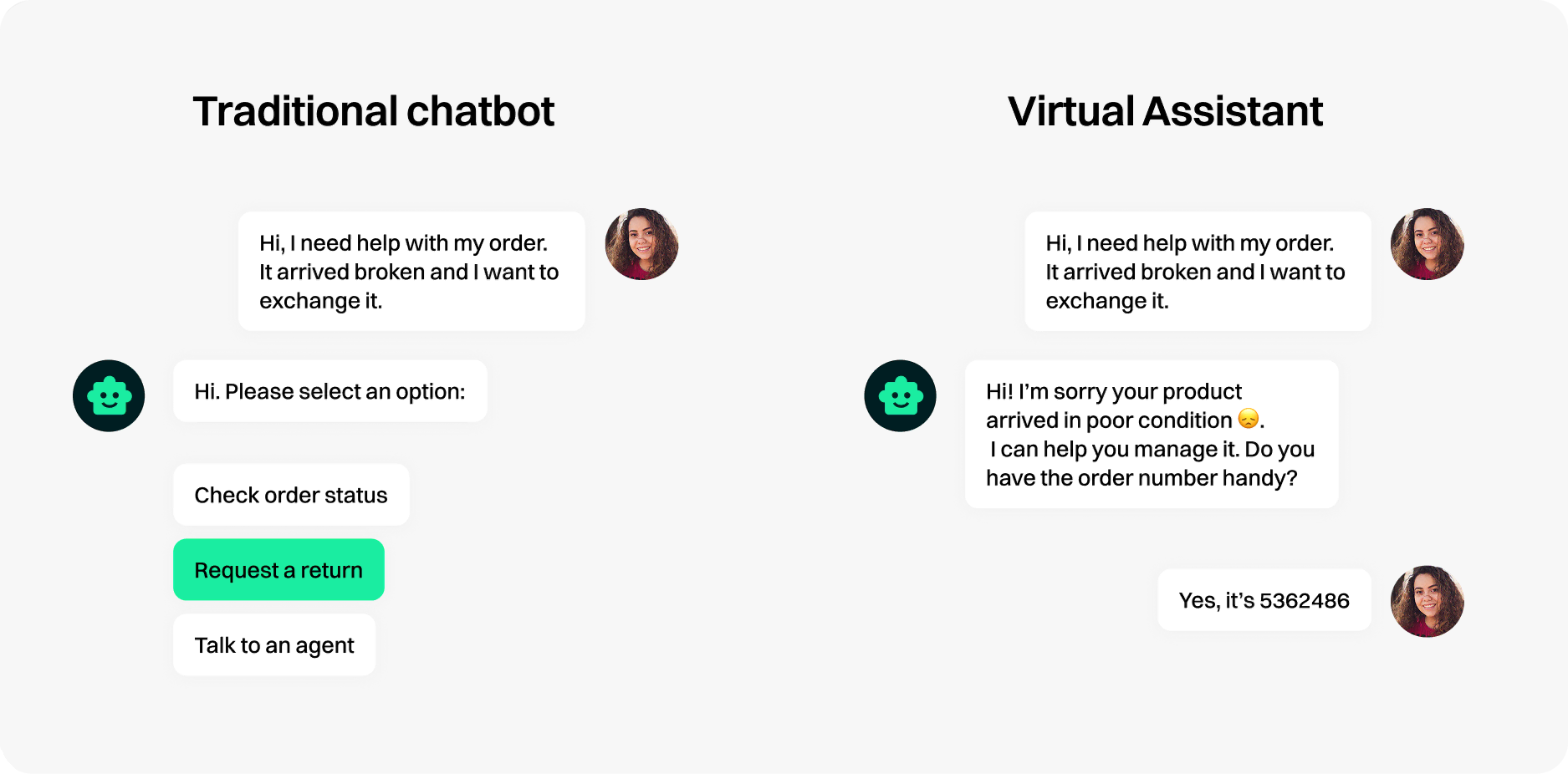
What are the tangible competitive advantages beyond cost savings?
Customer Satisfaction: The ultimate metric
Contrary to popular belief, consumers do not reject automation; they reject bad experiences. Experience shows us that the majority of users prefer to interact with an efficient virtual agent rather than wait for a human representative, provided they get accurate and fast answers.
Companies that have implemented advanced virtual agents report significant increases in their satisfaction indicators, consolidating the idea that the quality of the experience matters more than the medium through which it is offered.
The economy of immediacy
Patience has become a scarce resource. Response time has established itself as a critical factor in the perception of service quality, with direct consequences on customer loyalty. Virtual agents not only eliminate wait times but respond in milliseconds, radically transforming service perception. This factor, seemingly simple, has a direct impact on retention and brand image.
Frictionless scalability
During special events, product launches, or unexpected crises, the volume of inquiries can multiply exponentially. Traditional contact centers are forced to choose between long wait times or costly temporary hires, neither being a satisfactory option.
Virtual agents eliminate this dilemma, offering unlimited capacity without degradation in service quality. This perfect scalability allows for maintaining operational excellence even in situations of extraordinary demand.
Omnichannel consistency
Modern consumers use multiple different channels to communicate with brands and expect absolute coherence across all of them. Information fragmentation has become one of the main causes of frustration in the customer experience.
Current virtual agents act as information centralizers, maintaining full context regardless of the channel used. A customer can start an inquiry via web chat, continue it on WhatsApp, and resolve it via a phone call, without needing to repeat information or perceive any discontinuity.
Overcoming barriers: Challenges and real solutions
The linguistic and cultural barrier
Traditional virtual agents have encountered significant limitations when facing dialectal variations, regional expressions, or specific cultural references. However, the most advanced models overcome these barriers through contextual adaptation techniques and region-specific learning.
Leading platforms in hospitality and travel have managed to handle hundreds of different languages, including dialectal varieties, with comprehension levels similar to those of native agents. This capability allows offering a genuinely global service without losing local personalization.
System integration
One of the biggest obstacles to the effective implementation of virtual agents has been integration with legacy technological infrastructures. Monolithic architectures, fragmented databases, and proprietary systems make it difficult to access the information needed to offer complete answers.
The emerging solution is abstraction layers that allow virtual agents to communicate with multiple systems without the need for costly migrations. This approach significantly reduces both implementation time and cost, democratizing access to this technology.
Organizational resistance
The implementation of virtual agents is not merely a technological challenge, but also an organizational one. Internal resistance, especially among customer service teams concerned about their job future, can seriously compromise the project’s success.
Organizations that have addressed this issue with transparency and reskilling programs have obtained significantly better results. The conversion of phone agents into AI supervisors and trainers not only mitigates resistance but also leverages accumulated knowledge to enhance system effectiveness.
The immediate horizon: emerging trends
Multimodal Agents
The communicative limitation of early virtual assistants, restricted to text, is being overcome through multimodal capabilities. The most advanced systems already incorporate:
- Image recognition and analysis.
- Voice processing with emotional detection.
- Generation of explanatory visualizations.
- Integration with augmented reality.
The ability to identify products from photographs, explain procedures through real-time generated graphics, or show functionality through augmented reality is radically transforming the scope and effectiveness of these systems.

Customer Digital Twins
These are predictive models that accurately simulate the preferences, needs, and behaviors of each user. This approach allows for customizing not just the content of the responses, but also the communicative style of the virtual assistant.
Users who interact with an assistant adapted to their psychological profile show greater satisfaction and engagement, consolidating the idea that personalization goes beyond what is said to also include how it is said.
Artificial emotional Intelligence
Current virtual agents already implement basic emotional intelligence capabilities, with significant advances in their continuous development. The most sophisticated systems integrate technologies that analyze facial expressions in video conferences, detect subtle variations in vocal patterns during calls, and identify specific linguistic markers in text interactions.
These types of features make it possible to identify emotional states and adjust the focus of attention. This provides added value, especially in sectors such as insurance, where pragmatic customers receive efficient and straightforward processes, while those in emotionally vulnerable situations are treated with greater empathy and support, significantly improving the user experience and the effectiveness of the service.
Strategic implementation goes beyond technology
The Virtual Agent as a brand extension
The most effective virtual agents are not merely functional tools, but authentic extensions of the brand personality. Their tone, vocabulary, and values must align perfectly with the corporate identity. This coherence significantly increases positive perception among users interacting with these systems.
Conversational design as a strategic discipline
Conversational design has emerged as a critical discipline in the implementation of virtual agents. It is not merely about programming answers, but about designing natural communicative flows that consider aspects such as:
- Human communication theory.
- Cognitive psychology.
- Cultural anthropology.
- Applied linguistics.
Measurement and continuous optimization
The most successful virtual agent programs establish clear metrics beyond traditional indicators like response time or resolution rate. They incorporate measurements of:
- Customer perceived effort.
- Emotional impact of the interaction.
- Influence on post-interaction behavior.
- Contribution to specific business goals.
Evaluation systems that correlate specific linguistic elements with subsequent satisfaction allow for continuous evidence-based optimization, beyond intuition or subjective perceptions.
Expert Opinion: An inevitable transformation
The implementation of virtual agents is not just a way to optimize operational processes: it represents a paradigm shift in the way companies communicate with their customers. Organizations that strategically commit to this transformation, combining powerful technology, good conversational design, and well-aligned teams, will not only see operational improvements: they will be building advantages that are difficult to match.
Projections indicate that by 2027, the vast majority of customer interactions will start with a virtual agent, and many of them will be resolved completely without the need for human intervention.
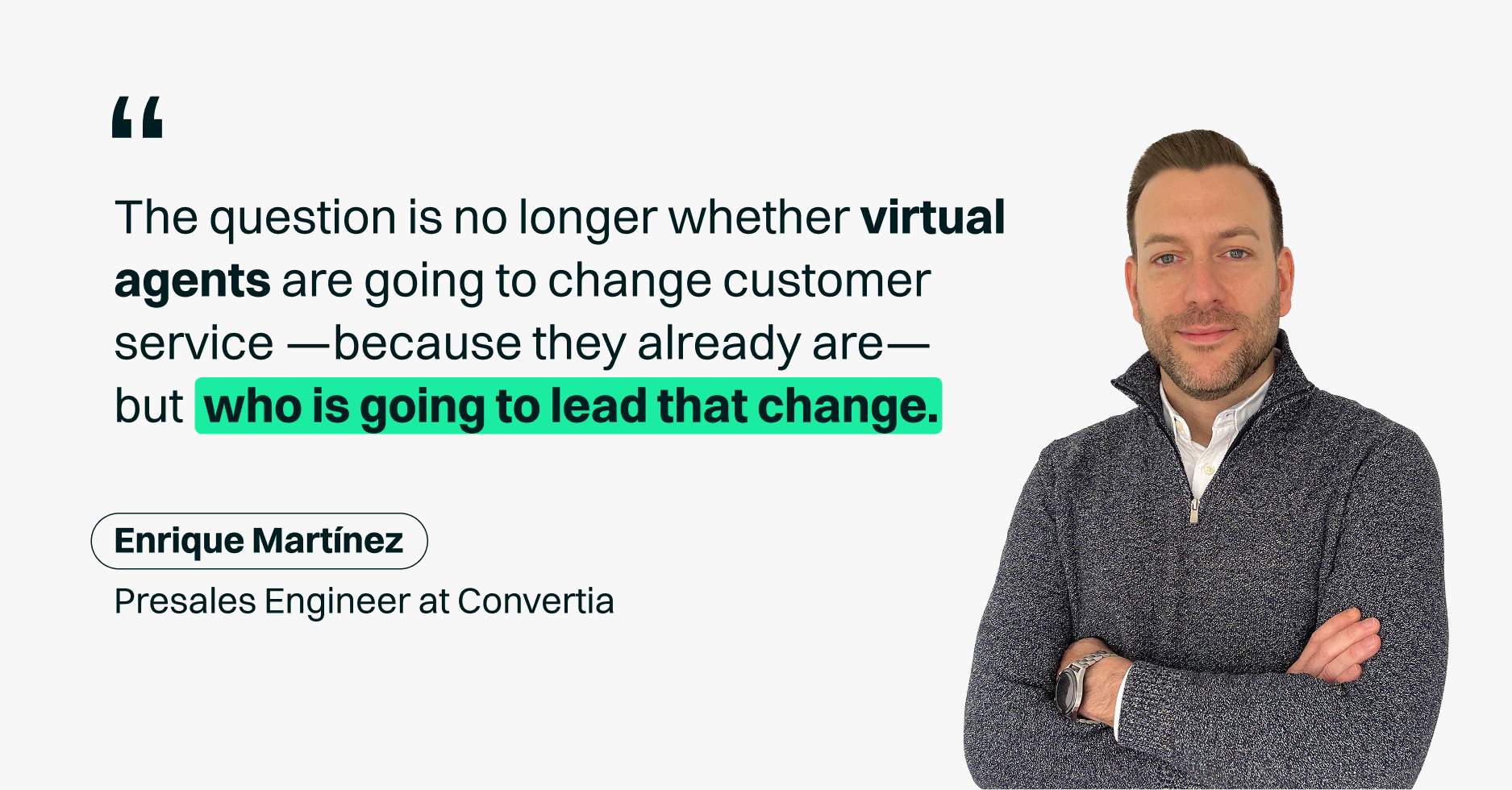
Now, the question is no longer whether virtual agents will change customer service, —cause they already are, but who will lead that change… and who will be left behind, unable to keep up with what consumers expect.
Is your company ready for this new era of customer service powered by intelligent virtual agents? Contact us to learn more.