











The traditional sales funnel has been the backbone of digital marketing and sales strategies for decades: awareness, consideration, conversion and retention. However, shifts in consumer behavior, omnichannel journeys and AI-driven decision-making are redefining how customers buy.
But something has fundamentally changed. Today, we face hyperconnected consumers who navigate an ocean of content, make impulsive decisions and follow unpredictable patterns. The reality is that buying behavior no longer fits into a linear, predictable model.
It is time to adopt an alternative approach that is dynamic, non-linear and enhanced by generative AI, aligned with how people actually buy today.
The classic linear sales funnel is broken
Consumers no longer behave as they once did.
Today’s consumer keeps multiple tabs open while comparing prices, reading reviews on Reddit, watching TikTok videos and asking friends on WhatsApp, all at the same time. A teenager might discover a product on Instagram and purchase it impulsively within seconds, while an executive may research for weeks before making a decision.
How many tabs do you open before buying something? Do you trust a spontaneous TikTok review more than a carefully crafted brand message?
This new reality exposes the main flaw of the traditional funnel: its linearity.
Today’s digital experience is not an orderly progression, but an interconnected network of micro-decisions that happen at unexpected moments.
Modern consumers constantly switch between channels and devices, conducting in-depth research even for relatively small purchases.
This fragmented behavior completely breaks the idea that customers follow a predictable and orderly path to purchase.
The new consumer decision-making dynamic. What has changed?
Power has definitively shifted to the consumer.
Social media has transformed the dynamics of influence, with micro-influencers generating more trust than large celebrities or branded advertising campaigns. Content created by real users now carries more credibility than even the most expensive advertising efforts.
Perhaps most revealing is the ‘consideration loop’: people continuously enter and exit the decision-making process. A potential customer may be ready to buy, then get distracted by another brand, completely forget their initial intent, and weeks later resume the journey from a completely different point.
Trust and authenticity have become the new currency. Brands perceived as genuine and transparent hold a clear advantage, regardless of where the customer is in their decision process.
Buying behavior has become non-linear. Consumers can jump directly from discovery to purchase, skipping intermediate stages entirely, or remain trapped in research cycles that seem endless. What matters most is recognizing that each individual follows their own unique path.

The new approach: experience, context and real-time personalization
Spoiler alert: don’t sell. Create meaningful experiences.
The solution is not to optimize the traditional funnel, but to build a strategy based on value-driven micro-moments. Every interaction, no matter how small, contributes to overall perception and the relationship with the brand.
Context has become critical. It means delivering the right message, at the right time, through the channel preferred by the consumer. It is no longer about bombarding audiences with repetitive messages, but about understanding exactly what each person needs.
It is time to start thinking of the ‘funnel’ as a continuous conversation cycle. This approach recognizes that people do not move linearly, but engage in intermittent dialogues with brands, moving closer or further away as their needs change.
Today’s consumers expect brands to remember their preferences, anticipate their needs and offer relevant solutions at the precise moment they are needed. This expectation of contextual relevance is what makes the traditional funnel feel increasingly outdated and mechanical.
What can you do to adapt your funnel to today’s consumer needs and behaviors?
Three strategic recommendations to optimize your funnel
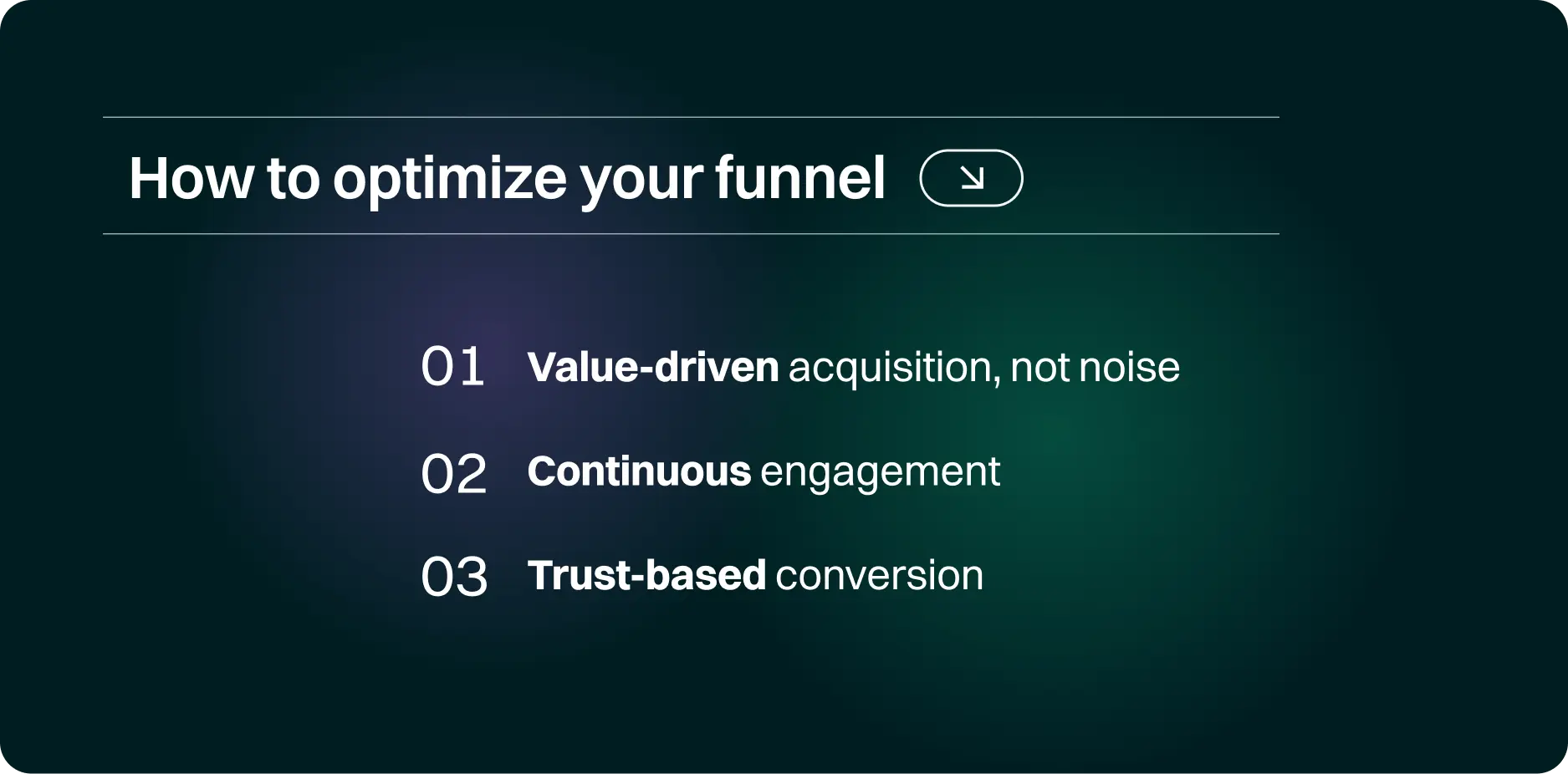
Value-driven attraction, not noise
Content must solve real problems, entertain or inspire. The key is to offer something consumers genuinely value, rather than trying to capture attention through intrusive tactics.
When you create useful, relevant content, consumers naturally find you when they need you.
Continuous interaction
Build relationships through meaningful conversations instead of message bombardment. Every touchpoint is an opportunity to deepen the relationship, not just to push a commercial message.
Brands that actively listen and respond authentically create long-lasting connections.
Trust-based conversion
When you have built a relationship based on value and trust, conversion happens naturally at the right moment. There is no need for aggressive ‘closing’ tactics because you are present when the customer is ready to decide. Trust built throughout the journey facilitates the final decision.
Key questions to assess and transform your strategy
About your customer knowledge
- Do you truly understand how your customers discover, research and decide to buy your products?
- Have you mapped all possible touchpoints, including those you do not directly control?
- Do you know what questions your customers ask at each stage of their decision process?
About your content and communication
- Does your content address real needs, or does it simply talk about your products/services?
- Do you have specific content for different stages of the customer journey, or do you use the same message for everyone?
- Does your brand have an authentic and recognizable voice, or does it sound like every other brand in your industry?
About your technology implementation
- Does your current technology allow you to recognize the same customer across different channels and devices?
- Can you personalize experiences in real time based on previous behavior?
- Have you explored how advanced technology (such as AI) could transform your responsiveness and relevance?
About your organizational mindset
- Is your team focused on pushing customers through a funnel or accompanying them on their unique journey?
- Is the customer experience the responsibility of a single department or the entire organization?
- Are you willing to abandon tactics that “have always worked” in favor of approaches that better respond to the current reality?
Step by step guide to optimizing your customer journey
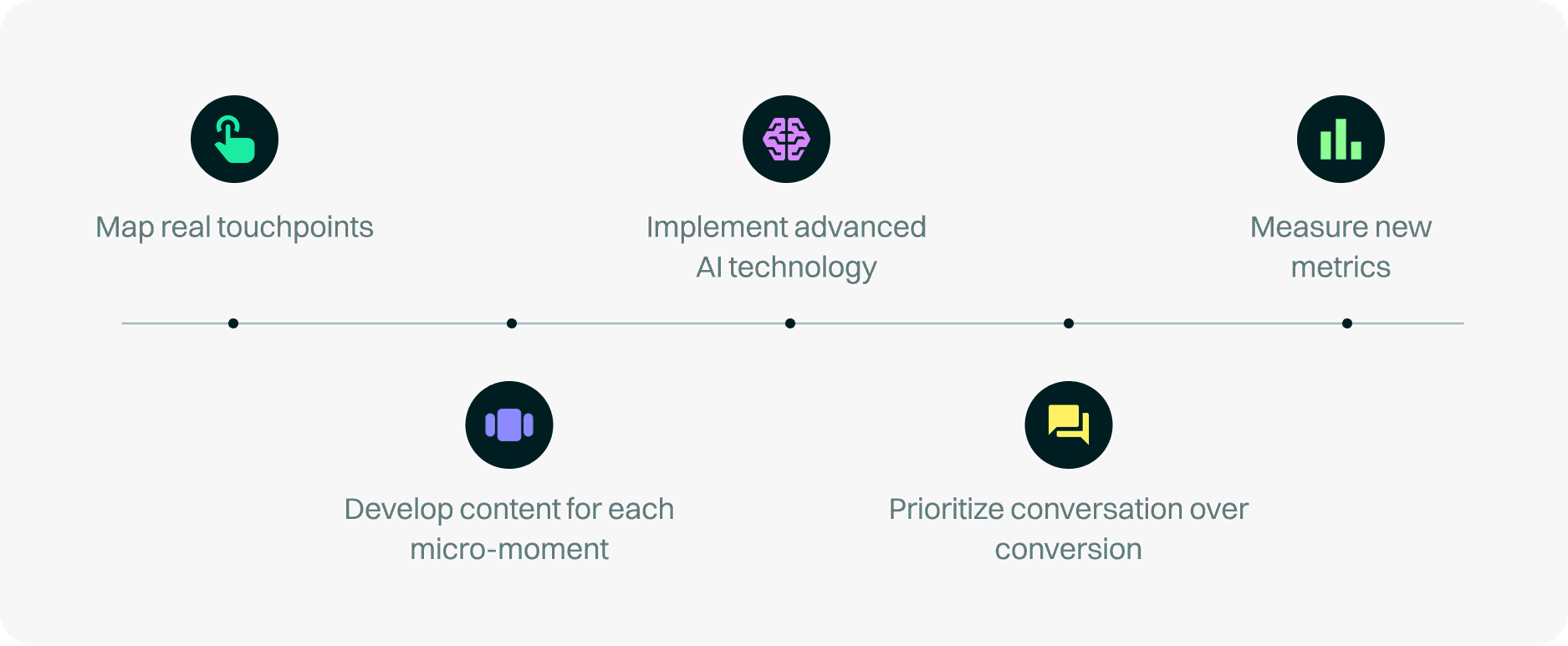
Map real touchpoints
Identify where your customers actually interact with your brand, not where you would like them to.
Develop content for each micro-moment
Create specific pieces for different moods, needs, and contexts.
Implement advanced AI technology
Use tools that can support you throughout your customer’s journey, from content creation with generative AI to efficient service from intelligent virtual agents.
Prioritize conversation over conversion
Focus on generating genuine dialogue rather than pushing for the sale.
Measure new metrics
In addition to conversions, evaluate relationship depth, sustained engagement, and customer lifetime value.
The next time you think about your marketing and sales strategy, ask yourself whether you are trying to force your customers through a rigid, outdated funnel or to build authentic relationships that evolve alongside their needs.
Brands that abandon the traditional funnel in favor of this approach, focused on meaningful experience,s are discovering that, in addition to significantly improving conversions, they are also building something much more valuable: lasting relationships with customers who become advocates and promoters of the brand.
The era of dynamic, personalized, AI-powered digital experiences has already begun, and strategically adapting your funnel is no longer just an advantage, it’s a necessity for continued growth.