










Introduction to Lead Scoring
The saturation of digital information has radically transformed the customer acquisition process. Companies face the challenge of managing growing volumes of potential clients while attempting to maintain commercial efficiency. This reality demands intelligent methods to distinguish between contacts with true potential and those who will probably never buy.
Let’s think about the daily situation of a sales team that receives 50 new contacts a day. Without clear prioritization criteria, salespeople must split their time equally among everyone. This generates frustration, lowers team morale, and wastes valuable resources on unsuitable prospects.
Lead Scoring emerges as a practical response to this challenge. This methodology assigns numerical values to each contact based on specific criteria, creating an objective classification system. Sales teams can then concentrate first on prospects with the highest probability of purchasing.
Through this article, you will learn the fundamentals of Lead Scoring and learn how to design a system adapted to your business to substantially improve your commercial results.
What is Lead Scoring and why is it important?
Definition of Lead Scoring
Consumer attention has become a scarce and valuable resource. Lead Scoring offers substantial advantages to capitalize on this reality:
- Smart use of limited resources
- Acceleration of the sales process
- Collaboration between Marketing and Sales
- Personalization of the customer experience
- Improvement in conversion rates
Capturing contacts requires significant investments, and Lead Scoring marks the difference between strategies based on quantity versus those based on quality. It represents an approach that maximizes Marketing ROI while accelerating business growth.
The fundamental pillars of a lead scoring system
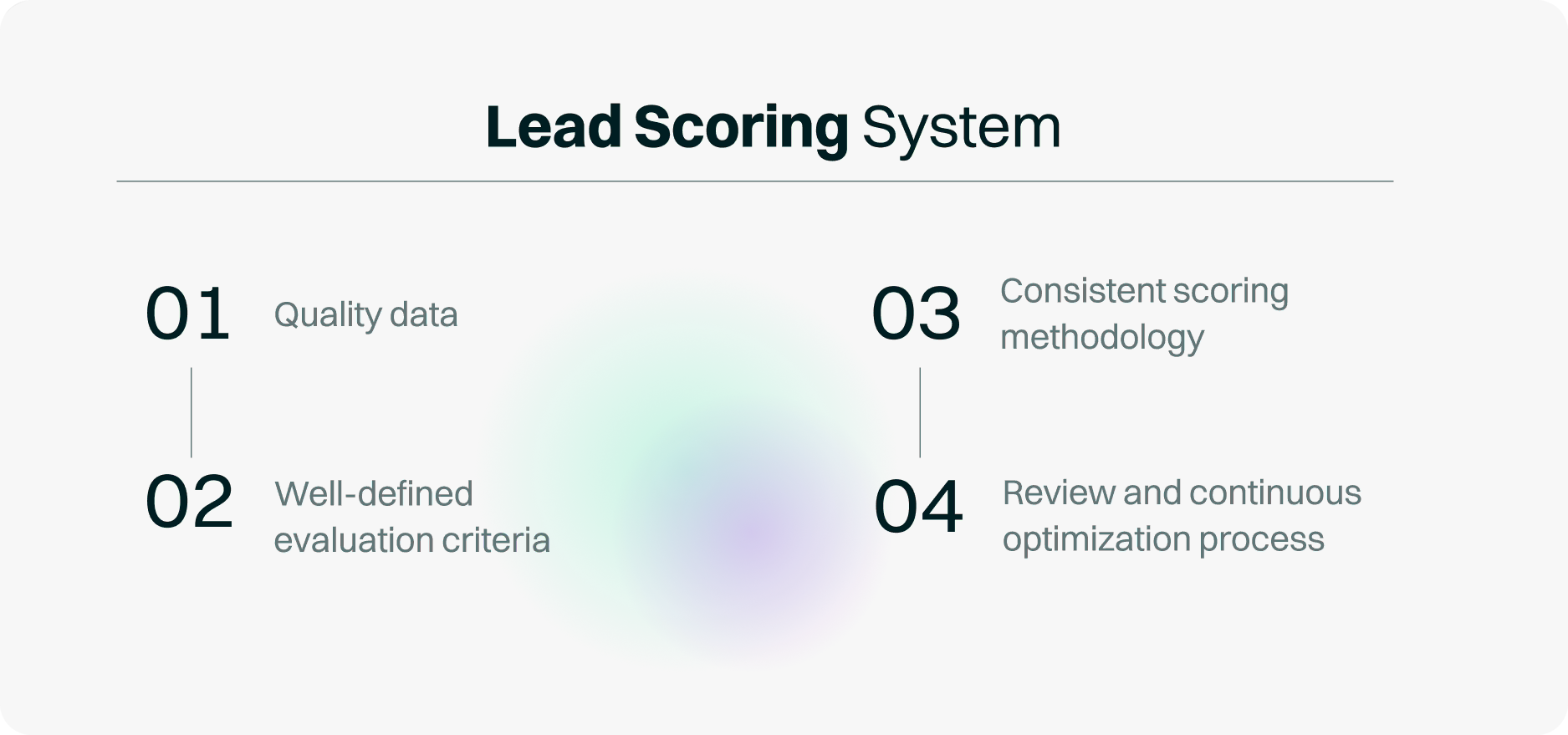
To build an effective and lasting Lead Scoring system, it is essential to understand and properly develop its four fundamental pillars.
1. Quality data A
Lead Scoring system is only as good as the data it is based on. The quality, relevance, and completeness of the information collected about your leads will largely determine the accuracy of your scores. Data must be:
- Accurate and updated: Obsolete or incorrect information will inevitably lead to erroneous evaluations.
- Relevant to your business model: Not all data has the same predictive value for all industries or product types.
- Sufficiently granular: The more detailed the available information, the more refined your scoring system can be.
- Ethically obtained and compliant: Especially considering regulations like GDPR in Europe.
The implementation of robust CRM tools like Infunnel and the integration of the company’s different data sources are critical steps to guarantee this solid foundation.
2. Well-defined evaluation criteria
An effective Lead Scoring system must incorporate multiple evaluation dimensions that, together, offer a comprehensive view of each lead’s potential. These criteria are usually grouped into three main categories:
- Demographic and Firmographic Criteria: Objective characteristics of the lead or their company that determine if they fit your Ideal Customer Profile (ICP). They include factors such as geographic location, company size, industry sector, professional title, education level, etc.
- Behavioral Criteria: Actions the lead takes that indicate their level of interest and engagement. For example, visits to specific pages on your website, content downloads, time spent on your site, email interaction, etc.
- Temporal Criteria: The recency and frequency of interactions, which are usually key indicators of the current level of interest. A lead who visited your website 24 hours ago generally has higher potential than one who did so three months ago.
3. Consistent scoring methodology
Once the criteria are defined, it is necessary to establish a coherent system to assign scores. The most common methodologies include:
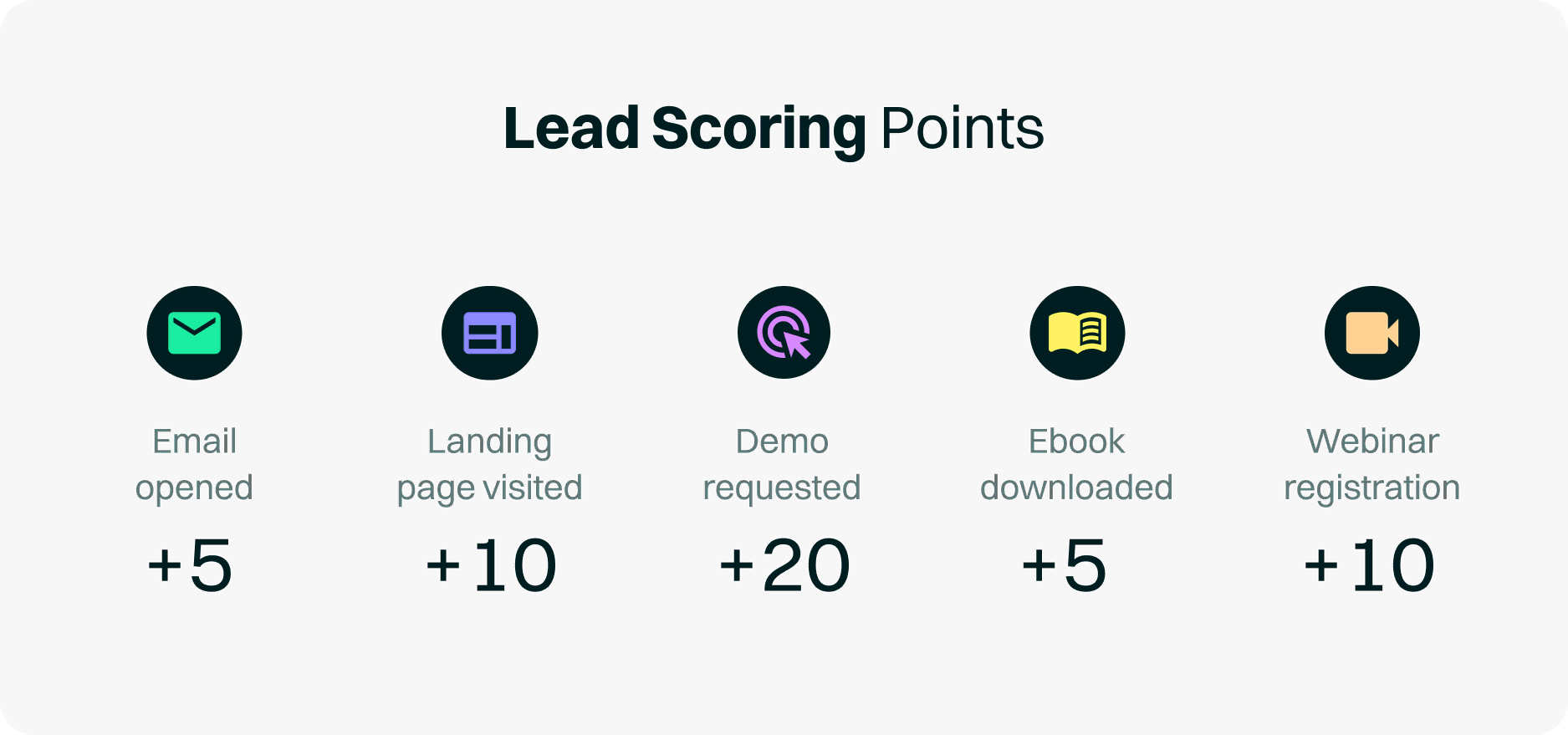
- Numerical systems: Assignment of specific points for each action or characteristic (e.g., +10 points for downloading a whitepaper, +5 for opening an email).
- Alphabetical systems: Categorization by letters (A, B, C, D) according to different evaluation dimensions.
- Hybrid systems: Combination of numerical scores with qualitative classifications.
Whatever method is chosen, it must be: understood and accepted by all stakeholders involved, applied consistently to all leads, flexible enough to adapt to market changes, and documented in detail.
4. Continuous review and optimization process
A Lead Scoring system is not a static construction, but a living organism that must constantly evolve. To maintain its effectiveness over time, it is imperative to:
- Establish clear success metrics: Indicators that allow evaluating if the system is meeting its objectives (conversion rate, sales cycle velocity, etc.).
- Perform periodic audits: Systematic reviews to identify possible mismatches between assigned scores and actual results.
- Incorporate Sales team feedback: Salespeople are on the front lines and can provide valuable insights into score accuracy.
- Retrospective conversion analysis: Study the characteristics and behaviors of leads that effectively became customers to refine scoring criteria.
How to implement an effective lead scoring system
Phase 1: Preparation and preliminary analysis
1. Formation of a multidisciplinary team
The first critical action is to constitute a team that integrates complementary perspectives: Marketing representatives (market/funnel knowledge), Sales representatives (direct experience with leads), Data analysts, and CRM/Technology managers.
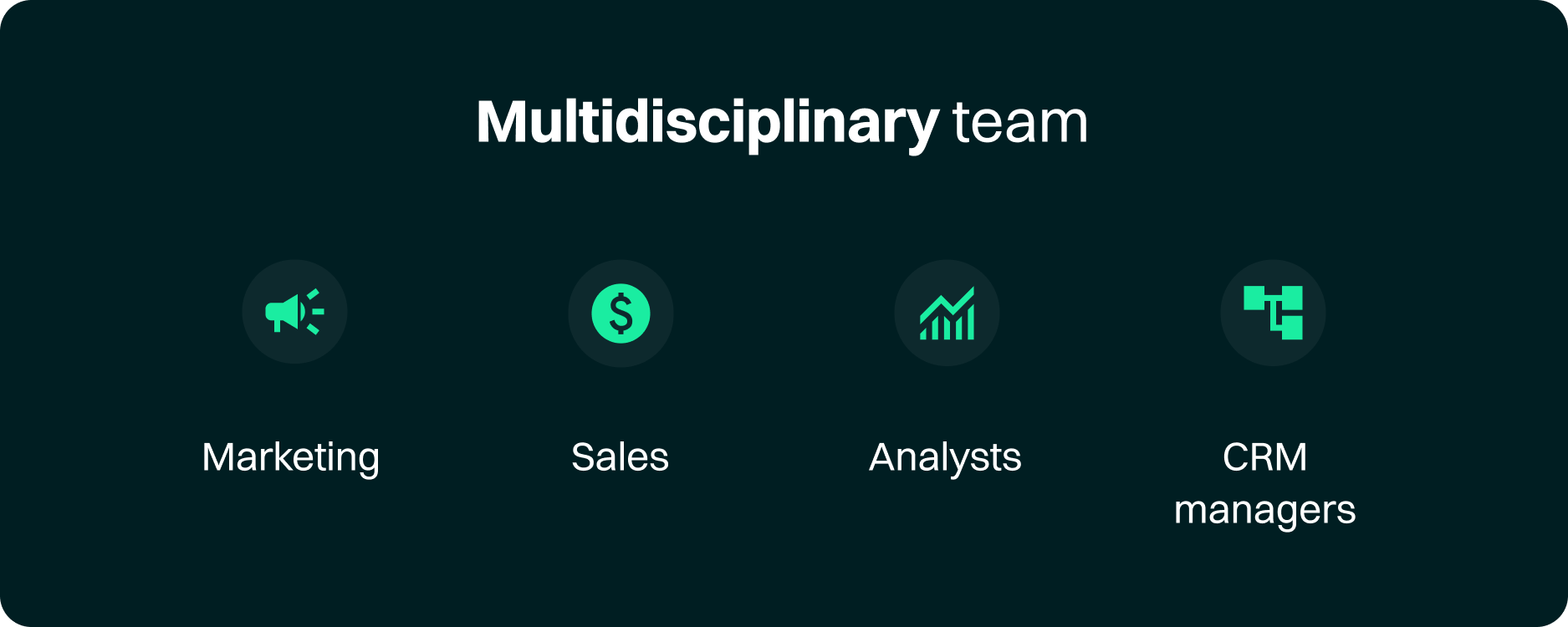
This team will be responsible for designing, implementing, and overseeing the entire process, ensuring that the needs and perspectives of all departments involved are taken into account.
2. Audit of available data
Before designing any model, perform an exhaustive inventory of: existing data sources (CRM, Marketing Automation, web analytics), quality of historical data, information gaps, and systems to be integrated.
3. Buying cycle analysis
Understand in depth how your current customers made the purchase decision: map the Customer Journey, identify influential touchpoints, determine average cycle duration, and identify common obstacles.
Phase 2: Scoring Model Design
1. Defining the Ideal Customer Profile (ICP)
Precisely establish the characteristics of the customer that best fits your offering:
- Demographic/firmographic characteristics (age, gender, location, company size, industry, etc.)
- Specific needs and pain points that your solution addresses
- Available resources (budget, equipment, technology)
- Factors that determine the success of your solution’s implementation
The more accurate this profile is, the more effective your scoring system will be.
2. Setting scoring criteria
Determine which attributes and behaviors will be evaluated:
1. Demographic/firmographic criteria:
- Industry or sector
- Organization size (employees, revenue)
- Geographic location
- Contact’s position/role
- Available budget
- Technologies currently in use
2. Behavioral criteria:
- Pages visited and frequency
- Content downloaded or consumed
- Interaction with emails
- Registrations for webinars or events
- Participation in product demonstrations
- Specific requests for information
- Activity on corporate social media
3. Assigning weights and values
Determine the relative importance of each criterion:
- Use historical data to identify the most predictive factors for conversion
- Assign numerical values to each action or characteristic
- Set the score threshold that determines when a lead is ready to move to sales
For more sophisticated structures, consider implementing a two-dimensional system:
- Fit score: how well the lead fits your ideal customer
- Interest score: level of engagement demonstrated
Phase 3: Technical and operational implementation
1. Technology selection and implementation
Choose the right tools for your model and resources:
- Configure your CRM or marketing automation platform to support the model
- Establish the necessary integrations between systems
- Implement automated triggers and workflows
- Configure dashboards and reports for monitoring
2. Process documentation
Create detailed documentation that includes:
- Complete description of the model and its logic
- Guide to interpreting scores
- Action protocols according to score ranges
- Responsibilities of each department
- Procedures for maintenance and updating
This documentation will be essential for onboarding new team members and ensuring consistency in the application of the system.
3. Team training
Prepare all stakeholders to use the system effectively:
- Training sessions for marketing and sales teams
- Clear explanation of expected benefits
- Practical instructions on how to interpret and act according to scores
- Channels for feedback and question resolution
Effective adoption by teams is as important as the technical design of the system.
4. Initial trial period
Before full launch:
- Implement the system in parallel with existing processes
- Evaluate a sample of leads with the new system
- Compare results with the previous process
- Make adjustments based on this pilot pase
This calibration period is crucial for identifying problems or misalignments before full-scale implementation.
Phase 4: Measurement, optimization, and continuous improvement
1. Establishment of KPIs
Define clear metrics to evaluate the success of the system:
- Conversion rate from MQL (Marketing Qualified Leads) to SQL (Sales Qualified Leads)
- Sales closing rate by score range
- Average sales cycle time
- Predictive accuracy of the model (qualified leads that actually convert)
- ROI of marketing activities by score segment
2. Continuous monitoring
Implement a regular monitoring system:
- Weekly reviews of key metrics
- Monthly audits of model accuracy
- Quarterly feedback from the sales team on the quality of leads received
3. Model refinement
Establish a formal optimization cycle:
- Retrospective analysis of successful vs. failed conversions
- Identification of new patterns or predictive behaviors
- Adjustment of weightings based on observed results
- Incorporation of new relevant criteria
4. Adaptation to market changes
Keep the system up to date with changes in:
- Consumer behavior
- Product or service offerings
- Competitor strategies
- New acquisition channels
Remember that a Lead Scoring system is never “finished”; it is a living organism that must constantly evolve to maintain its effectiveness.
A well-designed Lead Scoring system allows you to prioritize what’s important, align teams, and focus resources where there is real conversion potential.
It’s not about working harder, but working smarter. Implementing it on a solid foundation and keeping it constantly evolving is key to sustaining efficient and profitable business growth.
Discover Infunnel, the CRM and Marketing Automation tool that allows you to do Lead Scoring and boost your strategies.